Pest guide · spiders
National spider methodology: spider hub, how we treat spiders, spider guarantees, spider control by area. Identification: spider identification. Related: black button spider guide, brown button spider guide, violin spider guide, sac spider guide, rain spider guide, baboon spider guide, huntsman spider guide, cellar spider guide, golden orb weaver guide, wolf spider guide.
Salticidae — vision-led stalkers, not orb-web waiters
Jumping spiders are among the most charismatic and least understood spiders around homes and gardens. They do not build the big prey-catching webs people usually associate with spiders. Instead, they are active daytime hunters that rely on exceptional eyesight, precise stalking, and controlled leaps. South African sources describe them as harmless and beneficial around homes because they feed on insects rather than on people or pets.
A jumping spider belongs to the family Salticidae. This family is famous for its compact body, large forward-facing eyes, alert movements, and curious behaviour. In South Africa, jumping spiders are common on walls, in gardens, around windows, and on plants. They are free-living hunters rather than web-bound ambush spiders.
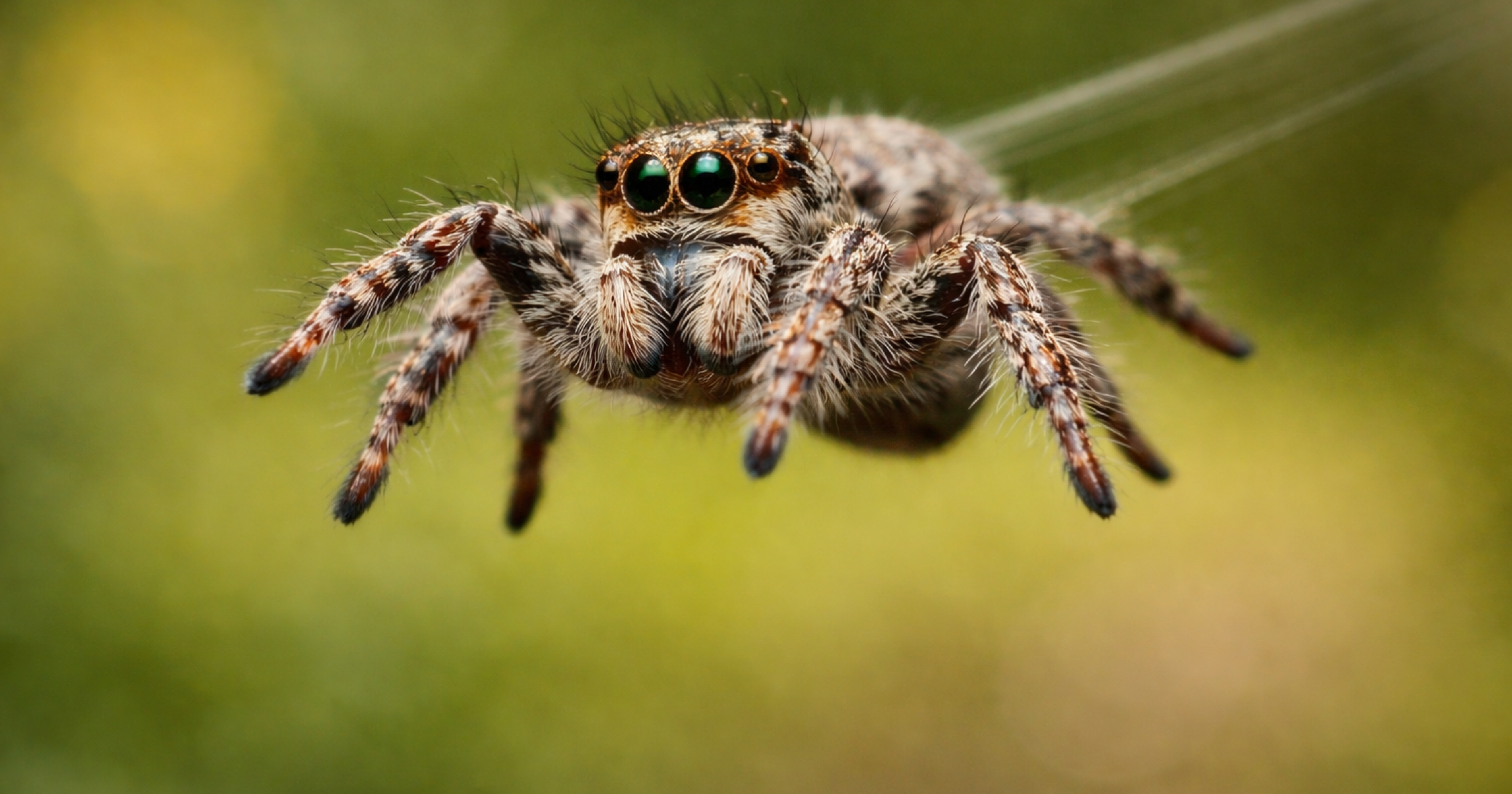
Jumping spiders are usually easy to recognise once you know what to look for. Their most distinctive feature is the set of large forward-facing front eyes, which gives them a very different look from most other spiders. They are usually small, compact, hairy, and quick-moving, often stopping, turning, and visually inspecting things before moving again. South African references describe them as common around dwellings, on walls, and in gardens.
Jumping spiders are widespread in South Africa and occur in a wide range of habitats, from vegetation and gardens to walls and other parts of human dwellings. The South African Salticidae guide confirms that the family is highly diverse in the country, while the African Snakebite Institute describes them as common in and around houses and gardens.
People notice jumping spiders because they seem unusually “aware.” They often turn to face movement, watch objects closely, and move in a way that looks deliberate rather than random. That impression is not imaginary. Reviews of jumping spider biology describe them as visually guided predators with a uniquely advanced visual system among spiders.
Most people think the jumping spider's greatest strength is the jump itself.
That is only part of the story.
The real hidden advantage of jumping spiders is their extraordinary visual system. Reviews describe their eyes as functionally specialised: the large principal eyes provide very high spatial resolution and detailed target inspection, while the secondary eyes monitor the broader surroundings and help detect movement around them. In plain language, they do not just see well “for a spider” — they hunt using a layered visual system that separates fine focus from wide-angle awareness.
This makes the jumping spider very different from web spiders or simple ambush hunters. A jumping spider can:
This is the real “special power”: its true advantage is not raw jumping power. It is precision vision combined with calculated movement. That is what makes jumping spiders so exceptional. They hunt more like tiny visual predators than like typical passive spiders. One review even called them “eight-legged cats,” which is a very fitting description of how they stalk and pounce.
A very common misconception is that jumping spiders leap recklessly. They do not. Sources note that they often use silk as a dragline or belay line when leaping and climbing. So even though they do not spin prey-catching webs, silk still plays an important role in their movement and safety.
That is a great example of why jumping spiders are so effective: they combine vision, jumping, and silk engineering in one compact hunter.
Jumping spiders succeed because they combine:
That combination makes them one of the most advanced visual hunters among spiders. They are not just tiny jumpers. They are tiny sight-led predators.
One of the most interesting lesser-known facts about jumping spiders is that their visual system is effectively split into jobs. Their main eyes inspect detail, while their other eyes monitor the wider surroundings. Science News summarised this neatly: the principal eyes can focus on a prey target while the secondary eyes keep watch for other movement, including danger.
That divided system is one of the reasons they seem so unusually alert and intelligent for such tiny animals. That last point is an inference from their documented visual specialisation and behaviour.
Indoors they are usually harmless insect predators—gentle cup-and-card relocation is enough if you prefer them outside. For repeat sightings with ID uncertainty versus problem species, get a quote aligns with national spider methodology on your quote.
The jumping spider is one of the most remarkable spiders in South Africa. It is not formidable because it is large, venomous, or web-heavy. It is formidable because it is a precision visual hunter. Its true supremacy lies in its ability to see, judge, stalk, and leap with extraordinary accuracy for such a small animal.
Next: wolf spider guide, golden orb weaver guide, cellar spider guide, huntsman spider guide, rain spider guide, black button spider guide, brown button spider guide, violin spider guide, sac spider guide, baboon spider guide, how we treat spiders, spider guarantees, spider identification guide. Book spider control in Cape Town. Read spider treatment safety.
Salticidae — large front eyes and daytime stalking separate them from sac spiders and web-first species at a glance. Your quote defines treatment scope.
Beneficial jumpers vs problem species? Use get a quote for identification-led advice.
We confirm what you are seeing first, then advise on harmless Salticidae versus problem species and quoted control where needed—national spider methodology; your quote prevails.
Wolf spider guide, Golden orb weaver guide, Cellar spider guide, Huntsman spider guide, Rain spider guide, Black button spider guide, Brown button spider guide, Violin spider guide, Sac spider guide, Baboon spider guide, How we treat spiders, Spider guarantees, Spider control by area, Spider identification guide. Hub: spider control.