Pest guide · spiders
National spider methodology: spider hub, how we treat spiders, spider guarantees, spider control by area. Identification: spider identification. Related: black button spider guide, brown button spider guide, violin spider guide, sac spider guide, rain spider guide, baboon spider guide, huntsman spider guide, cellar spider guide, golden orb weaver guide, jumping spider guide.
Lycosidae — ground hunters with signature eyes
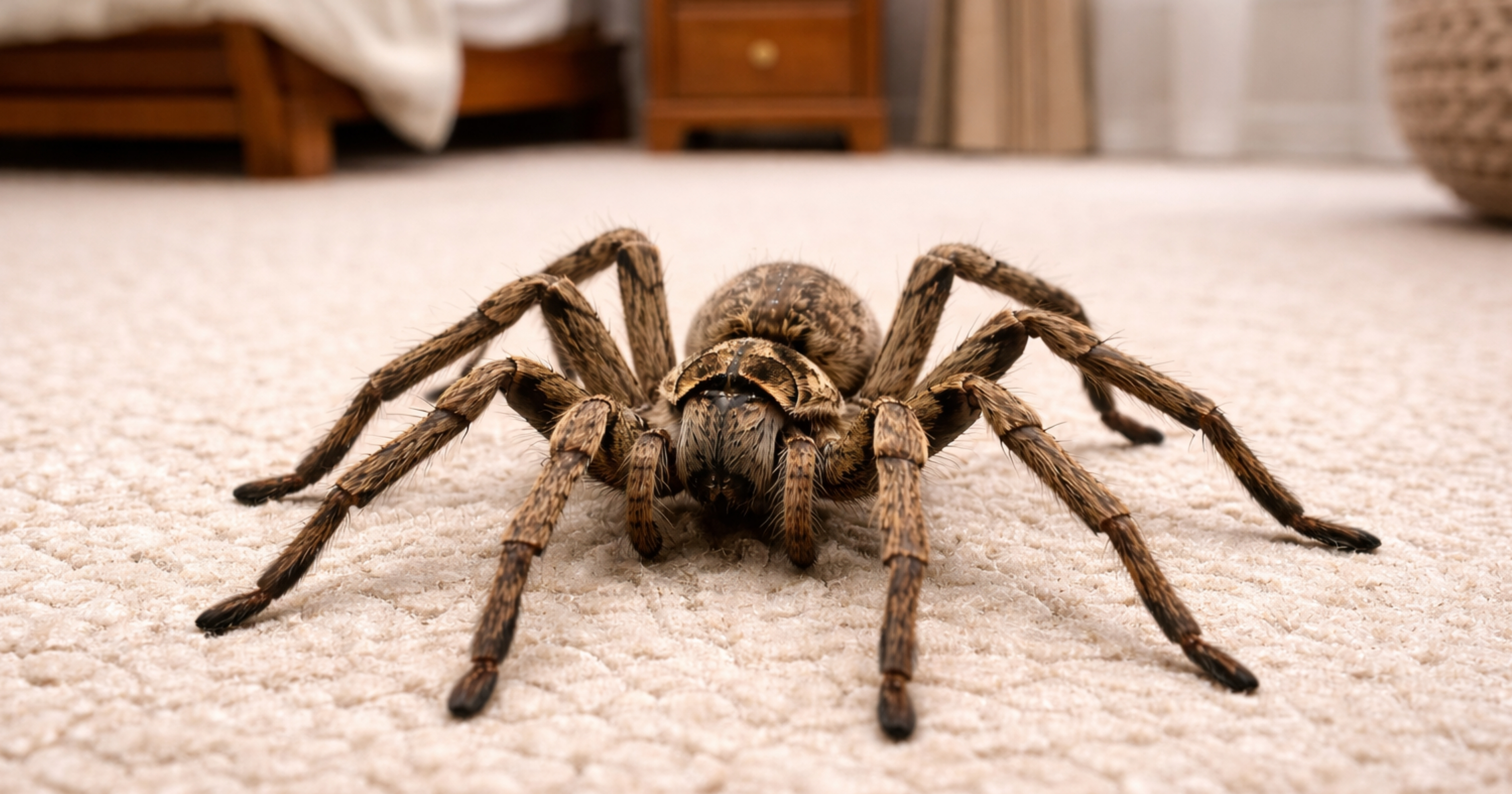
The wolf spider is one of the most capable ground-hunting spiders in the world. Unlike web-bound spiders, wolf spiders are active hunters that rely on speed, camouflage, and excellent vision rather than a large prey-catching web. They are usually brown, grey, or tan, which helps them blend into sand, soil, bark, and leaf litter.
Wolf spiders belong to the family Lycosidae. Britannica describes them as dark, long-legged, hairy spiders with excellent eyesight and a very distinctive eye pattern: four small eyes in the bottom row, two very large eyes in the middle row, and two smaller eyes above. That eye layout is one of the best ways to recognise a wolf spider family member.
Wolf spiders are usually recognised by a combination of:
Wolf spiders occur in a wide range of habitats and are especially associated with ground-level hunting zones. They are commonly found on soil, grass, paths, bark, rocks, and leaf litter rather than sitting in a typical orb web. Their colouring helps them disappear into the ground almost instantly.
People notice wolf spiders because they are:
They also trigger alarm because they do not sit quietly in a web. They move like hunters, which makes them seem more dangerous than they usually are. From a medical point of view, spiders overall are generally considered far less dangerous to humans than people commonly fear, and wolf spiders are not classed among the major medically important South African spiders.
Most people think the wolf spider's biggest strength is speed.
That is true, but the deeper advantage is vision-linked hunting.
Britannica specifically notes that wolf spiders have excellent eyesight, which is unusual enough to be one of their defining traits. Combined with their powerful legs and camouflage, that gives them a huge advantage: they do not need to wait in a web. They can see, stalk, and rush prey directly.
A web-building spider controls one fixed area.
A wolf spider can patrol and hunt wherever prey is active.
That makes it a far more flexible predator. It can respond to movement, shift hunting spots, and use terrain rather than silk as part of its strategy. This is what makes wolf spiders such successful generalist hunters.
This is the real “special power”: its hidden advantage is not just running fast. It is the combination of good vision, ground camouflage, and direct pursuit hunting.
This is one of the most remarkable things about wolf spiders and one of the best facts for a guide page. Female wolf spiders are famous for carrying their egg sac attached to the spinnerets, and after the spiderlings hatch, the young often ride on the mother's back. Among spiders, that is one of the most visually distinctive and well-known forms of parental care.
This gives the young a survival advantage during their most vulnerable stage. It also means that what looks like a “furry back” on a female may actually be dozens of babies riding on her body. That is one of the most surprising and memorable wolf spider traits.
Wolf spiders succeed because they combine:
That combination makes them effective predators without needing a permanent prey-catching web.
A lesser-known detail is that the eye arrangement is not just decorative identification — it reflects a spider that depends heavily on visual awareness. The two very large middle eyes are one of the reasons wolf spiders are such capable hunters compared with many more web-dependent spiders. This is a careful inference supported by Britannica's note on their excellent eyesight and the family's distinctive eye pattern.
If one runs indoors, it is usually seeking cover rather than confrontation—gentle container relocation works well. For repeat ground-layer pressure or ID uncertainty, get a quote aligns with national spider methodology on your quote.
The wolf spider is one of the most impressive hunting spiders you are likely to see around the ground layer of a property. It is not formidable because it spins giant webs or relies on extreme venom. It is formidable because it is a mobile predator: fast, sharp-eyed, camouflaged, and backed by one of the most remarkable maternal-care systems in spiders.
Next: golden orb weaver guide, cellar spider guide, huntsman spider guide, rain spider guide, black button spider guide, brown button spider guide, violin spider guide, sac spider guide, baboon spider guide, jumping spider guide, how we treat spiders, spider guarantees, spider identification guide. Book spider control in Cape Town. Read spider treatment safety.
Lycosidae — eye rows and ground posture separate them from huntsman and baboon spiders at a glance. Your quote defines treatment scope.
Fast runners in living areas? Use get a quote for identification-led advice.
We identify the species context first, then advise on entry, harbourage, and quoted control where needed—national spider methodology; your quote prevails.
Golden orb weaver guide, Cellar spider guide, Huntsman spider guide, Rain spider guide, Black button spider guide, Brown button spider guide, Violin spider guide, Sac spider guide, Baboon spider guide, Jumping spider guide, How we treat spiders, Spider guarantees, Spider control by area, Spider identification guide. Hub: spider control.