Pest guide · spiders
National spider methodology: spider hub, how we treat spiders, spider guarantees, spider control by area. Identification: spider identification. Related: black button spider guide, brown button spider guide, violin spider guide, rain spider guide, baboon spider guide, huntsman spider guide, cellar spider guide, golden orb weaver guide, wolf spider guide, jumping spider guide.
Cheiracanthium — yellow / house sac spiders
In South Africa, “sac spider” usually refers to spiders in the genus Cheiracanthium. They are small to medium-sized, pale wandering spiders that do not build prey-catching webs. Instead, they make a silken sac-like retreat for resting, moulting, and egg protection, then leave it at night to hunt. South African arachnid sources and broader spider references consistently describe them as nocturnal, free-living hunters that are commonly found on plants and sometimes inside houses.
A sac spider is not a single species. For a South African pest guide, the most relevant group is Cheiracanthium, especially species such as Cheiracanthium furculatum, which SANSA notes is one of the best sampled and most studied sac spiders in southern Africa. These spiders are widely distributed in southern Africa and are well known because they occur both outdoors on vegetation and indoors where their silk retreats are often noticed in folds of fabric, curtains, bedding, and corners.
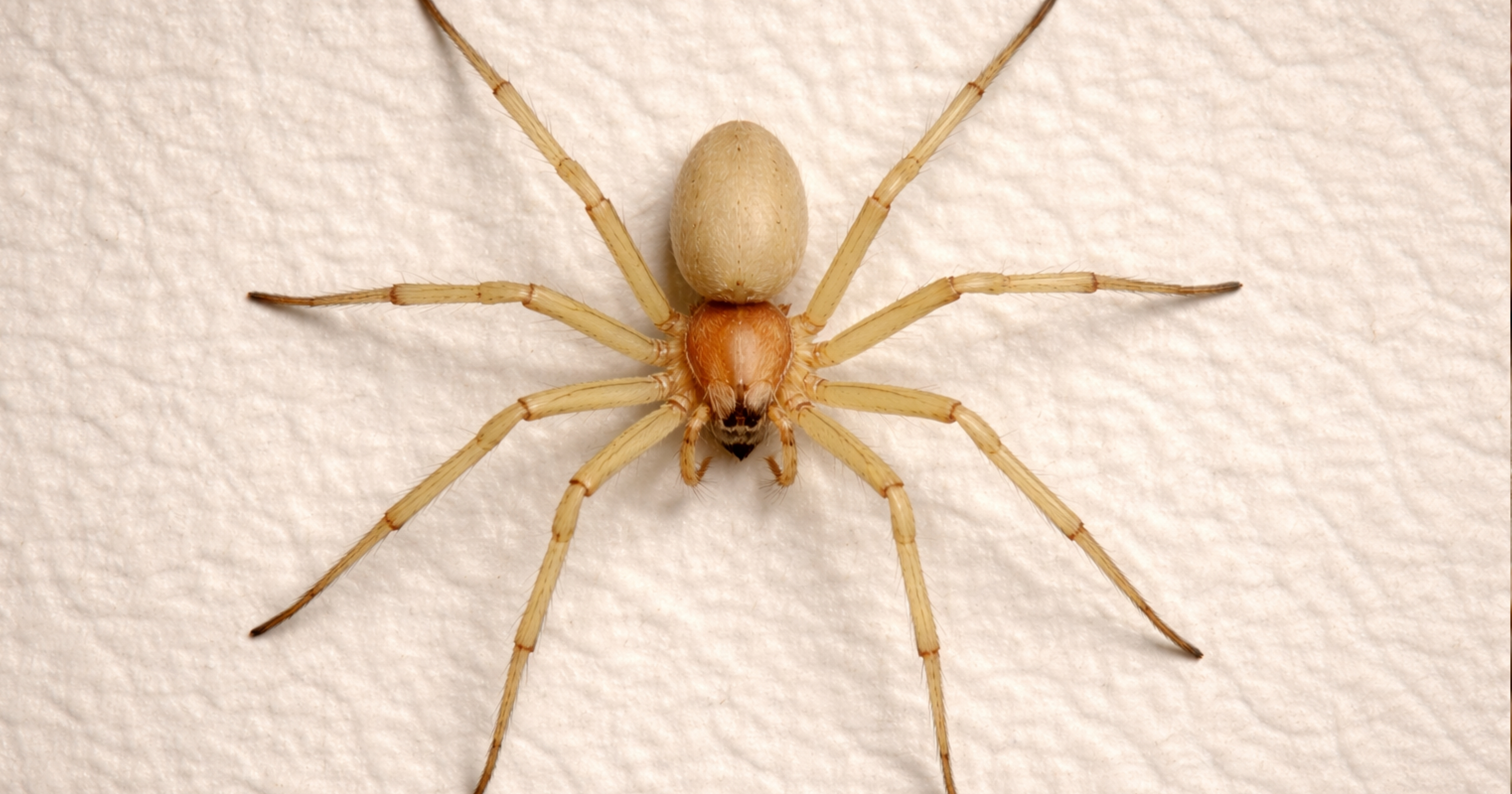
Sac spiders are usually pale yellow, straw-coloured, beige, or light brown, often with a slightly darker cephalothorax and conspicuously darker mouthparts. They have a slim body, long front legs, and a soft-looking, lightly glossy appearance. Their most distinctive sign is often not the spider itself but the flat silken sac retreat they build in sheltered places. ARC's South African factsheet describes these retreats clearly and notes that they can be found in folds of fabric and other protected spots during the day.
Sac spiders are common on vegetation, where they hunt among leaves and stems and hide by day in their silk retreats. They also enter buildings incidentally and may establish themselves indoors if conditions suit them. South African agricultural work records Cheiracanthium furculatum as a common predator in crops, while general references note that members of the genus commonly hunt on plants and may wander into houses.
One reason sac spiders are noticed more than many other spiders is that they are wandering nocturnal hunters. They do not stay anchored in a visible orb web. They move. ARC's South African factsheet notes that they can become entangled in bedding and may bite when threatened, which helps explain why people often associate them with indoor encounters. Their habit of hiding in fabric folds also makes them much more likely to end up in close contact with people than spiders that stay in one fixed web.
Most people think the sac spider's main strength is its bite.
That is not the most interesting thing about it.
The lesser-known trait that makes sac spiders so effective is that they use silk not mainly as a trap, but as a portable survival strategy. They build a compact retreat almost anywhere suitable, rest there safely by day, then emerge at night to hunt actively. This gives them a major advantage: they combine the flexibility of a roaming hunter with the protection of a built shelter. South African and broader references consistently describe Cheiracanthium as nocturnal, free-living hunters that hide in a silk sac-shaped retreat when inactive.
That means the sac spider is not dependent on a fixed hunting web like an orb weaver. It can:
That combination makes it a remarkably adaptable spider.
South African agricultural literature describes Cheiracanthium as aggressive hunters that kill prey they encounter, even when they do not always feed on every capture. That is a striking trait. It means they are not passive ambush spiders waiting for food to blunder into a snare. They are active predators that can suppress a wide range of small arthropods. In agricultural settings, this is one reason they are considered environmentally important as natural enemies of pest insects.
This is where the most confusion exists.
South African medical and arachnid sources do classify Cheiracanthium among the country's cytotoxic spiders, and ARC's South African factsheet states that they can cause local tissue damage and sometimes significant lesions. At the same time, SANSA's 2021 note on Cheiracanthium furculatum says misinformation about the species is widespread and has caused problems with diagnosis and public understanding. In other words, the species can be medically important, but the internet often turns that into overstatement.
Seek medical advice for any bite that worsens, ulcerates, or comes with spreading pain or systemic symptoms—and avoid diagnosing skin lesions from photos alone. For recurring indoor encounters, bedding or nursery concerns, or uncertain ID, use professional identification and a quoted control plan rather than folklore.
Sac spiders succeed because they combine:
That makes them very different from spiders that depend on one fixed web site for survival.
Sac spiders are not just nuisance spiders. South African agricultural and biodiversity work shows they are also part of the natural predatory community in crop systems and vegetation. Their role as active arthropod predators means they can help suppress insect pests. SANSA's overview of Cheiracanthium furculatum explicitly highlights both its medical and environmental importance.
The sac spider is one of South Africa's most misunderstood spiders. It is not simply “a dangerous house spider,” and it is not just a harmless wandering insect-hunter either. It is a highly adaptable nocturnal predator whose real strength lies in its combination of active hunting and silk shelter-building. That is what makes it successful outdoors and indoors — and that is the truth that most people miss.
Next: black button spider guide, brown button spider guide, violin spider guide, rain spider guide, baboon spider guide, huntsman spider guide, cellar spider guide, golden orb weaver guide, wolf spider guide, jumping spider guide, how we treat spiders, spider guarantees, spider identification guide. Book spider control in Cape Town. Read spider treatment safety.
Cheiracanthium — identification-led harbourage treatment on quoted scope; medically important species deserve accurate diagnosis and professional assessment when bites or recurring indoor activity are a concern.
Bedding or curtain sacs? Use get a quote for a safe plan.
We identify problem species and harbourages first, then treat and advise on sealing and clutter—national spider methodology; your quote prevails.
Black button spider guide, Brown button spider guide, Violin spider guide, Rain spider guide, Baboon spider guide, Huntsman spider guide, Cellar spider guide, Golden orb weaver guide, Wolf spider guide, Jumping spider guide, How we treat spiders, Spider guarantees, Spider control by area, Spider identification guide. Hub: spider control.