Pest guide · spiders
National spider methodology: spider hub, how we treat spiders, spider guarantees, spider control by area. Identification: spider identification. Related: rain spider guide, black button spider guide, brown button spider guide, violin spider guide, sac spider guide, baboon spider guide, cellar spider guide, golden orb weaver guide, wolf spider guide, jumping spider guide.
Sparassidae — laterigrade hunters
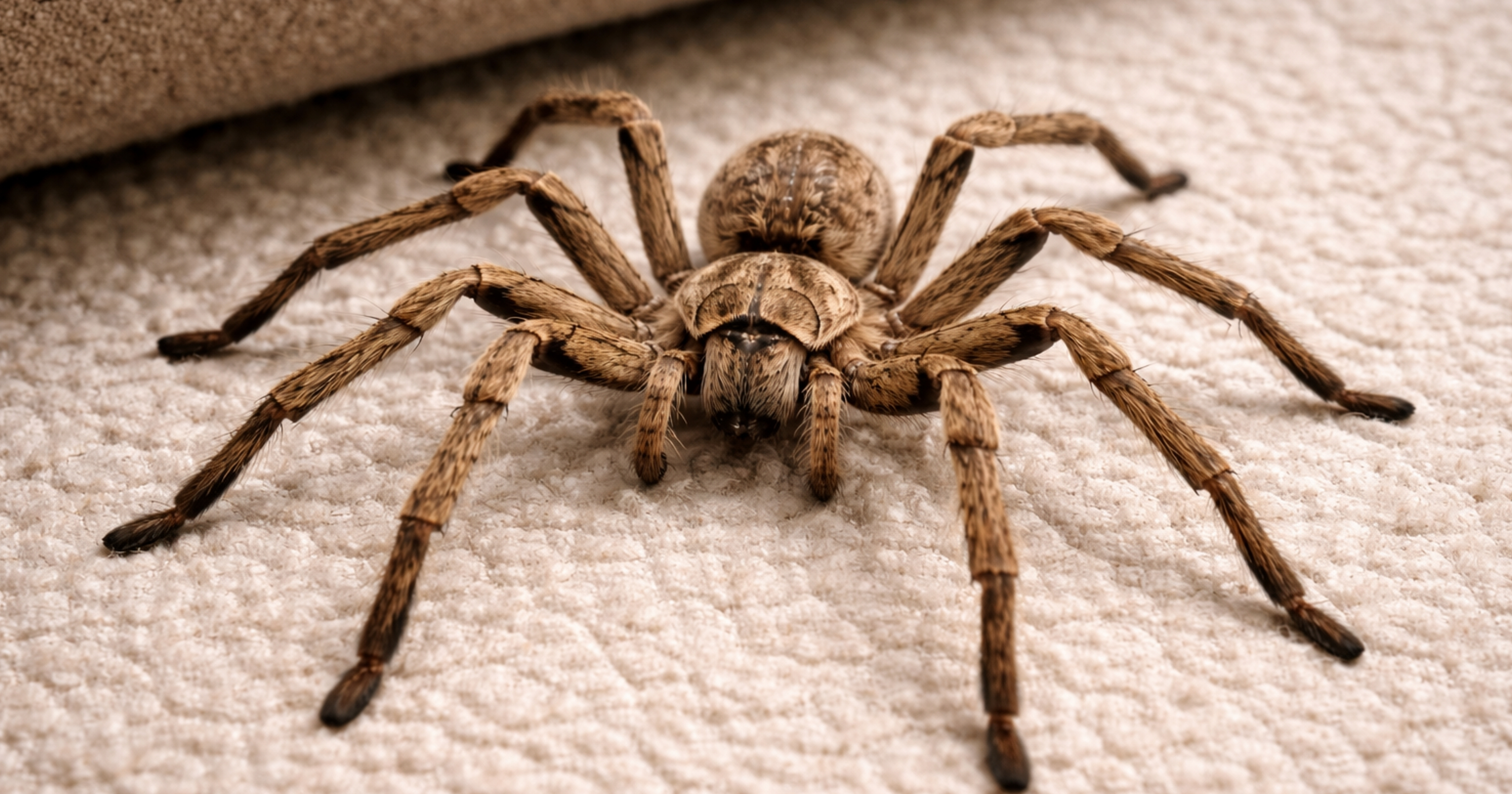
Large, fast, flat-bodied, and alarming at first glance, the huntsman spider is one of the most misunderstood spiders found around homes. Huntsman spiders belong to the family Sparassidae, a group known for speed, active hunting, and their distinctive laterigrade legs that extend sideways in a crab-like posture. In South Africa, huntsman spiders are part of the country's arachnid fauna, and they are commonly confused with rain spiders and other large wandering spiders.
A huntsman spider is not a web-dependent house spider. It is an active hunter. Members of Sparassidae generally do not build prey-capture webs as adults. Instead, they move across walls, bark, crevices, vegetation, and ceilings in search of insects and other prey. They are named “huntsman” because of this hunting style and their speed.
Huntsman spiders are usually identified by shape more than colour.
They are commonly mistaken for:
But huntsman spiders are typically flatter and more sideways-legged than those spiders. Their leg posture is one of the best clues.
Huntsman spiders are associated with tree bark, crevices, rock surfaces, vegetation, and buildings, and they often wander into houses and even vehicles. They are especially suited to tight spaces because of their flattened bodies. This is one reason they can suddenly appear from behind curtains, wall hangings, cupboards, and other narrow gaps.
Huntsman spiders are usually feared because of their size and speed, not because they are among the most medically important spiders. Their real household relevance is that they are predators of insects and other arthropods. Studies and general natural-history sources describe sparassids as active predators that feed mainly on insects and other invertebrates, and sometimes even on small vertebrates such as geckos or skinks.
That means they are not household pests in the same way as cockroaches or silverfish. In many cases, they are incidental indoor predators that have followed prey indoors.
Most people think the huntsman spider's greatest strength is speed.
Speed matters, but the deeper advantage is its body design.
The huntsman spider's most impressive trait is the combination of:
This gives it access to a kind of hunting zone many predators use poorly: the thin spaces of bark, cracks, furniture gaps, wall edges, and ceiling surfaces.
This spider is not just fast in open space. It is especially effective in tight, shallow, awkward spaces.
That makes it formidable because it can:
That is the real biological edge that makes huntsman spiders so effective. It is not just raw speed. It is surface control and crevice-hunting mobility. This is an inference based on their documented flattened bodies, laterigrade legs, and habitat use.
One especially interesting huntsman trait is that males of Heteropoda venatoria have been documented producing substrate-borne signals during courtship after detecting female chemical cues. In simple terms, the male can send vibrations through the surface he is standing on. Humans may even hear this as a faint rhythmic ticking in quiet conditions.
That is a remarkable trait because it shows huntsman spiders are not just visual sprinters. At least in some species, they also use mechanical communication in a surprisingly refined way.
A huntsman bite can be painful, and some sources report local symptoms such as swelling and pain, with more serious reactions possible in sensitive individuals. But the evidence base and bite reporting can be messy, and spider-bite diagnosis is often complicated by misidentification. In southern African medical literature, the spiders of greatest routine medical concern are not huntsman spiders but groups such as Latrodectus and Loxosceles.
So the balanced truth is this: Huntsman spiders are not harmless, but they are also not in the top tier of medically important household spiders in southern Africa.
They are difficult to deal with because they combine:
This is why a huntsman can seem to “disappear instantly.” In many cases, it has not gone far. It has simply gone flat and sideways into a space people cannot easily inspect. That is an inference from their morphology and behaviour.
Prefer gentle container relocation over swatting—surprise and cornering increase bite risk. For recurring indoor appearances, get a quote can align sealing, harbourage checks, and prey context with your quoted spider methodology.
The huntsman spider is one of the most impressive spiders people find around buildings. It is not “supreme” because it has the strongest venom or the biggest web. It is formidable because it is flat, fast, surface-adapted, and brilliantly built for hunting in awkward spaces. That is what makes it such an effective predator — and such a startling visitor when it turns up on a wall at home.
Next: rain spider guide, black button spider guide, brown button spider guide, violin spider guide, sac spider guide, baboon spider guide, cellar spider guide, golden orb weaver guide, wolf spider guide, jumping spider guide, how we treat spiders, spider guarantees, spider identification guide. Book spider control in Cape Town. Read spider treatment safety.
Sparassidae — active hunters; compare carefully with rain spiders and baboon spiders before assuming medical risk. Your quote defines treatment scope.
Behind a picture frame or visor? Use get a quote for a measured plan.
We identify the species context first, then advise on harbourages, sealing, and prey—national spider methodology; your quote prevails.
Rain spider guide, Black button spider guide, Brown button spider guide, Violin spider guide, Sac spider guide, Baboon spider guide, Cellar spider guide, Golden orb weaver guide, Wolf spider guide, Jumping spider guide, How we treat spiders, Spider guarantees, Spider control by area, Spider identification guide. Hub: spider control.