Pest guide · spiders
National spider methodology: spider hub, how we treat spiders, spider guarantees, spider control by area. Identification: spider identification. Related: black button spider guide, brown button spider guide, sac spider guide, rain spider guide, baboon spider guide, huntsman spider guide, cellar spider guide, golden orb weaver guide, wolf spider guide, jumping spider guide.
Loxosceles spp. — recluse spiders
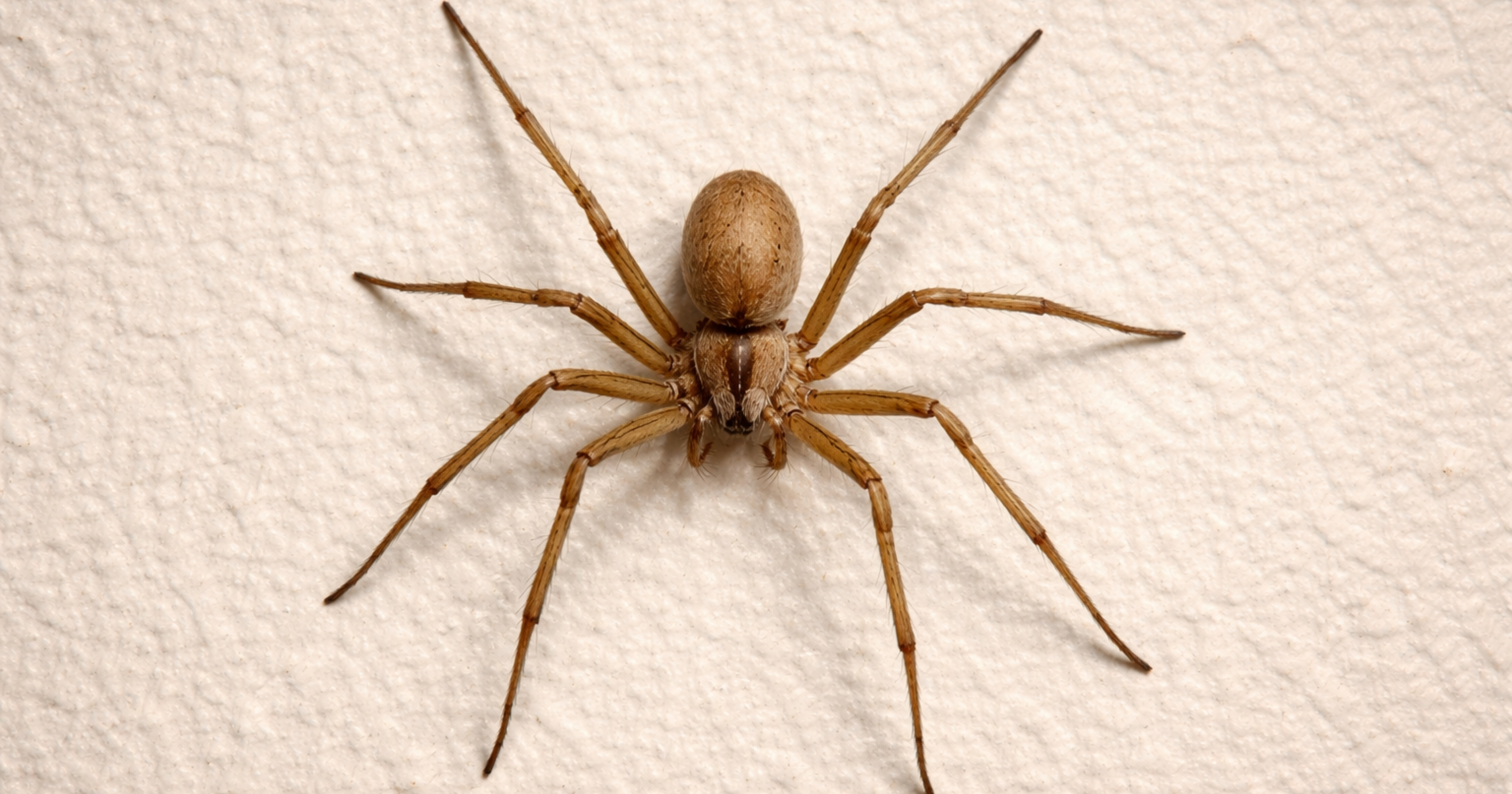
In South Africa, the name violin spider usually refers to spiders in the genus Loxosceles, a group also known internationally as recluse spiders. South African natural history references note that several Loxosceles species occur locally, so “violin spider” is a group name more than a single-species name. That is one reason identification gets messy so quickly.
A violin spider is a small to medium, six-eyed, mostly nocturnal hunting spider in the family Sicariidae. Biodiversity Explorer's South African guide points out that these spiders are called violin spiders because of the darker marking on the carapace that can resemble a violin shape, although that marking is not always equally obvious in every specimen.
An important South African fact-check review also noted that alarmist claims about violin spiders “invading” homes were overstated and unsupported. The spiders do occur in South Africa, but panic-style warnings often exaggerate both their abundance and how often serious bites are confirmed.
Violin spiders are usually:
The six-eye arrangement is one of the most important real identification clues. Many people rely only on a vague “violin mark,” but that is unreliable by itself because other brown spiders can look similar at a glance. South African references specifically highlight that Loxosceles spiders are unusual in having six eyes.
Violin spiders prefer quiet, sheltered, undisturbed places. South African sources describe them in places such as under rocks, bark, old timber, stored goods, dark corners, and sometimes inside buildings where there is little disturbance. Some local species are associated with caves, while others are more often found in dry sheltered places around natural or built environments.
That explains why they are called recluses. Their success comes partly from avoiding open exposure and staying in hidden retreats during the day.
Violin spiders matter because they are among the medically important spiders in southern Africa. South African medical-awareness material includes violin spiders among the spider groups of concern because their venom can damage tissue around a bite site in some cases. At the same time, confirmed bites are far less common than public fear suggests.
That is the key balanced truth: they are not harmless, but they are also not aggressive invaders that routinely attack people. Most concern comes from accidental contact, such as when a spider is trapped against skin in clothing, shoes, bedding, or stored items. This is consistent with recluse biology and South African public guidance.
Most people think the violin spider's greatest strength is venom.
That matters, but its more interesting advantage is stealth-based predation.
Violin spiders do not build prey-catching orb webs like orb weavers, and they do not charge around openly like wolf spiders. Their advantage is that they can spend the day hidden in protected retreats and hunt mostly at night with very little attention drawn to themselves. Their flat build, muted colouring, and reclusive behaviour make them exceptionally good at disappearing into cracks, clutter, bark, stone gaps, and dark household recesses.
This spider's strength is not domination through speed or size. It is domination through being missed. That gives it three major advantages:
Its hidden power is reclusive efficiency.
The violin spider is supreme in its niche because it is built to survive in tight, protected spaces where most people never look.
Most spiders have eight eyes. Violin spiders have six, arranged in pairs. That does not just make them easier to classify; it also marks them as a very distinctive spider lineage. In a pest-guide context, this matters because it is one of the few truly useful features that separates them from the many harmless brown spiders people wrongly call “recluses.”
Violin spiders are difficult because they combine:
This means people often do not know they are present until:
Suspected violin spider bites warrant professional medical advice—especially if a wound worsens, spreads, ulcerates, or you develop fever or systemic symptoms. Do not self-diagnose from social media or assume every brown mark was a recluse; capture or photo ID is unreliable without expertise. Use clutter reduction, gloves when moving stored goods, and professional assessment when spiders are found in living spaces.
The violin spider is one of the most feared and most misunderstood spiders in South Africa. Its reputation comes from real medical significance, but its success as an animal comes from something quieter: stealth, concealment, and reclusive efficiency. It is a spider built not to dominate a room, but to vanish inside it.
Next: black button spider guide, brown button spider guide, sac spider guide, rain spider guide, baboon spider guide, huntsman spider guide, cellar spider guide, golden orb weaver guide, wolf spider guide, jumping spider guide, how we treat spiders, spider guarantees, spider identification guide. Book spider control in Cape Town. Read spider treatment safety.
Loxosceles — identification-led harbourage treatment on quoted scope; recluse spiders deserve distance and professional assessment when bites are suspected.
Storage, bedding, or undisturbed corners? Use get a quote for a safe plan.
We identify problem species and harbourages first, then treat and advise on sealing and clutter—national spider methodology; your quote prevails.
Black button spider guide, Brown button spider guide, Sac spider guide, Rain spider guide, Baboon spider guide, Huntsman spider guide, Cellar spider guide, Golden orb weaver guide, Wolf spider guide, Jumping spider guide, How we treat spiders, Spider guarantees, Spider control by area, Spider identification guide. Hub: spider control.