Pest guide · spiders
National spider methodology: spider hub, how we treat spiders, spider guarantees, spider control by area. Identification: spider identification. Related: black button spider guide, brown button spider guide, violin spider guide, sac spider guide, baboon spider guide, huntsman spider guide, cellar spider guide, golden orb weaver guide, wolf spider guide, jumping spider guide.
Palystes — huntsman (e.g. P. superciliosus)
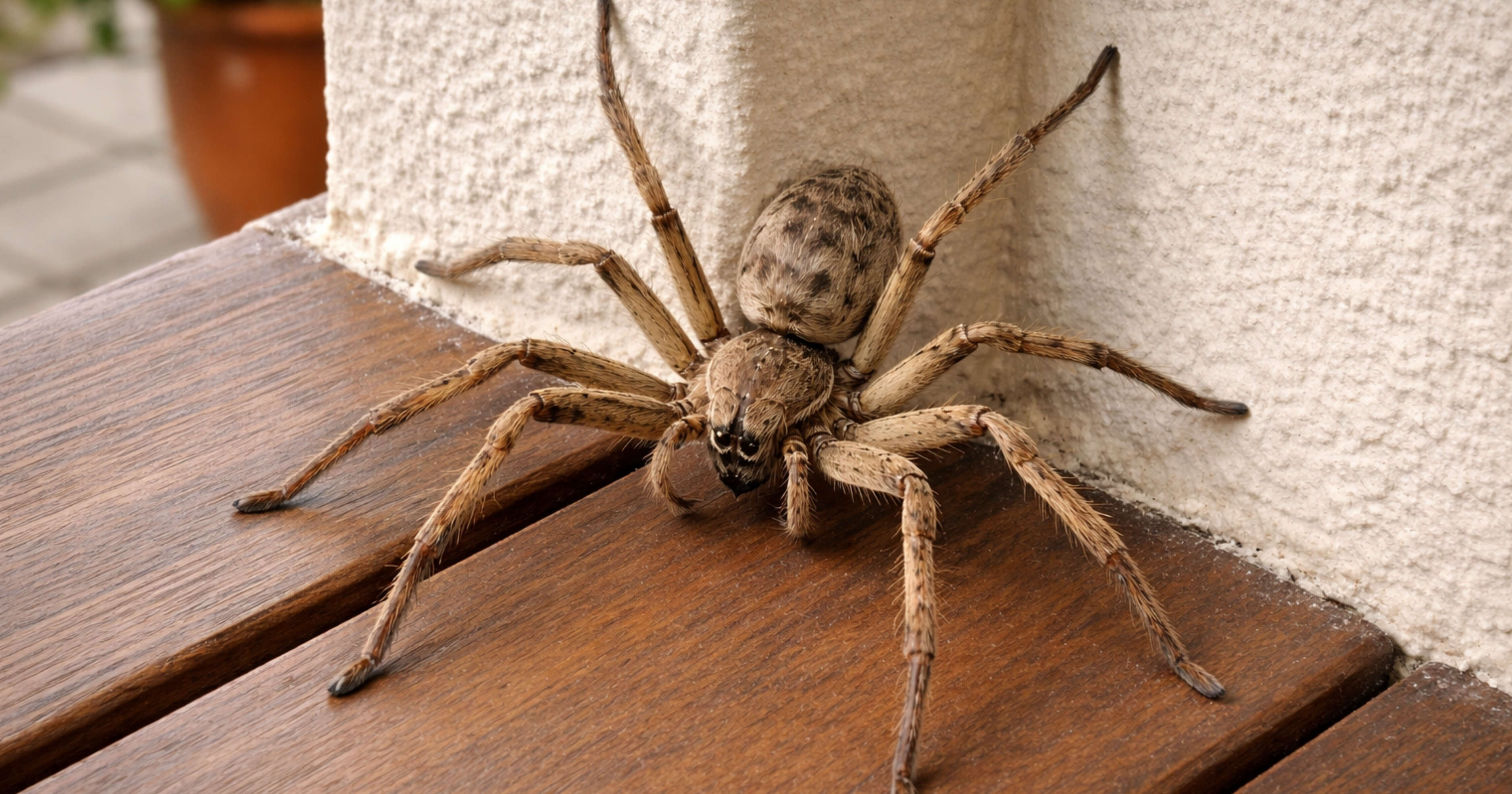
The rain spider is the South African common name most often used for large huntsman spiders in the genus Palystes, especially the common rain spider, Palystes superciliosus. It is one of the best-known large spiders in southern Africa and is famous for appearing in homes, gardens, curtains, and wall corners, especially during humid or rainy weather.
A rain spider is not a web-building house spider in the usual sense. It belongs to the huntsman spider family, Sparassidae, a group built for active hunting rather than waiting in a capture web. In southern Africa, the genus Palystes includes multiple rain spider species, and the most widespread and commonly recognised one is Palystes superciliosus.
Rain spiders are large, flat-bodied spiders with very long legs that spread sideways. That sideways leg posture is one of the key traits that separates them from bulkier baboon spiders. The African Snakebite Institute notes they are brown, often found flattened against walls or curtains, and can reach roughly 10 cm across the legs.
Rain spiders live both outdoors and indoors. Outdoors, females often build large silk-and-leaf retreats in shrubs and garden plants. Indoors, they may rest in curtains, high corners, behind wall hangings, or near ceilings. The African Snakebite Institute specifically notes that they are often encountered in houses, especially when it rains.
This is one of the biggest half-truths around rain spiders.
People often say they “come in because they know rain is coming.” That is not the best explanation. A better explanation is that rainy or humid conditions change prey movement and shelter conditions, and these spiders often end up in houses because houses provide dry cover, stable surfaces, and insects to hunt. Their common name reflects the timing of sightings more than a mystical weather sense. This is an inference from their documented habit of appearing indoors during rainy periods and from their identity as active huntsman spiders.
Most people think the rain spider's greatest strength is simply its size.
That is not the real secret.
Rain spiders are huntsman spiders, and their body design lets them move rapidly over walls, ceilings, bark, curtains, and other broad surfaces. Their flattened body and laterally splayed legs make them excellent surface hunters, not just ground hunters. That gives them a huge advantage over spiders that rely mainly on webs or slower ambush tactics.
A rain spider can:
That makes it an especially effective hunter in homes and gardens.
Rain spiders are sometimes called “lizard-eating spiders” in natural-history references to the genus Palystes. That nickname matters because it points to something many people do not realise: these are not tiny insect-only spiders in the usual sense. Large Palystes can overpower relatively substantial prey, including geckos in some situations. Biodiversity Explorer uses that common label for the genus, and a SANBI plant information sheet mentions rain spiders (Palystes) as a threat to geckos.
That does not mean every rain spider is constantly hunting lizards. It means they are capable predators with more power than many people assume.
Rain spiders are excellent at using flat, elevated, shaded surfaces. Because they can rest against walls, ceilings, curtains, bark, and foliage, they often remain unseen until they move. Their body shape is part of their concealment strategy.
If you want the real answer, it is this:
It combines reach, speed, and flat-surface control.
A rain spider does not need a trap web to dominate a room corner, curtain fold, shrub, or wall. It can patrol those surfaces directly, and that makes it one of the most efficient visible household predators in southern Africa. This is an inference based on its huntsman form and recorded indoor habits.
If a rain spider is indoors and you prefer it outside, gentle container-and-card relocation is often enough—avoid bare-handed grabbing because of the painful bite risk if trapped against skin. For recurring entry or high-traffic areas, get a quote can align sealing and prey context with your quoted scope.
The rain spider is one of South Africa's most iconic household spiders. It is not “supreme” because it is the most venomous or the most aggressive. It is supreme because it is a large, flat, highly mobile surface hunter that can dominate walls, ceilings, plants, and hidden corners with remarkable efficiency. That is what makes it such an impressive spider — and such a memorable one.
Next: black button spider guide, brown button spider guide, violin spider guide, sac spider guide, baboon spider guide, huntsman spider guide, cellar spider guide, golden orb weaver guide, wolf spider guide, jumping spider guide, how we treat spiders, spider guarantees, spider identification guide. Book spider control in Cape Town. Read spider treatment safety.
Palystes — large Sparassidae huntsman; startling indoors but not the same medical-risk class as button or violin spiders on common guidance. Your quote defines treatment scope.
Walls, curtains, or eaves? Use get a quote for a calm plan.
We identify the concern and species context first, then treat harbourages and advise on sealing and prey—national spider methodology; your quote prevails.
Black button spider guide, Brown button spider guide, Violin spider guide, Sac spider guide, Baboon spider guide, Huntsman spider guide, Cellar spider guide, Golden orb weaver guide, Wolf spider guide, Jumping spider guide, How we treat spiders, Spider guarantees, Spider control by area, Spider identification guide. Hub: spider control.