Pest guide · spiders
National spider methodology: spider hub, how we treat spiders, spider guarantees, spider control by area. Identification: spider identification. Related: black button spider guide, brown button spider guide, violin spider guide, sac spider guide, rain spider guide, baboon spider guide, huntsman spider guide, cellar spider guide, wolf spider guide, jumping spider guide.
Trichonephila — golden silk, giant orb webs
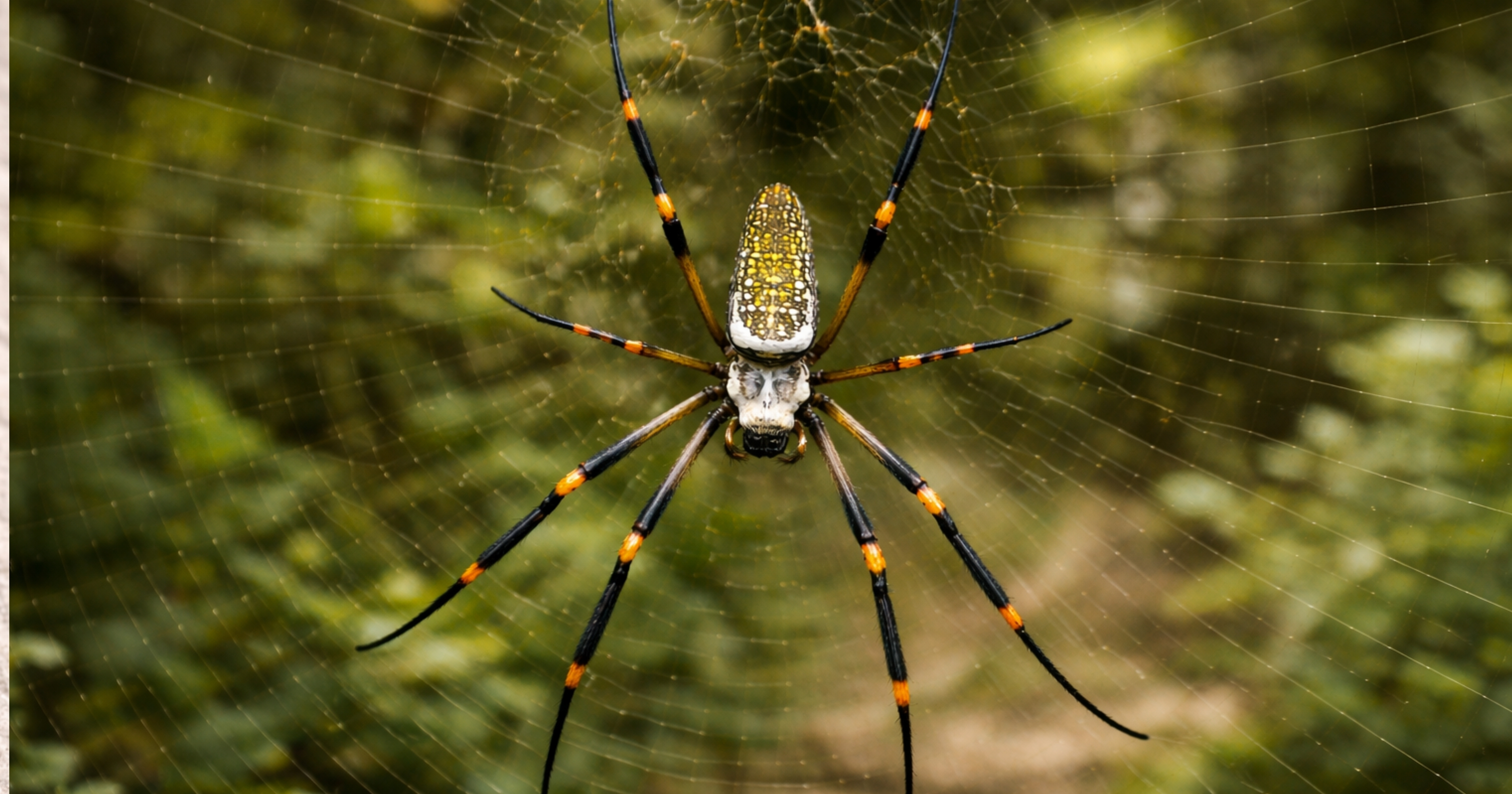
The golden orb weaver is one of the most striking spiders in southern Africa. It is famous for its huge golden web, its long-legged appearance, and the fact that it looks more dangerous than it really is. In South Africa, these spiders are generally regarded as harmless to humans and pets, even though their webs are large and impressive.
In South Africa, “golden orb weaver” usually refers to spiders in the genus Trichonephila, including the banded-legged golden orb-web spider (Trichonephila senegalensis) and the black-legged golden orb-web spider (Trichonephila fenestrata). T. senegalensis is widespread across South Africa, while golden orb weavers as a group are well known across southern Africa for their large golden webs.
Golden orb weavers are usually easy to notice because of three things:
South African sources describe the webs as very large, often spanning shrubs and open spaces, while T. senegalensis in South Africa builds orb webs roughly 1 to 1.5 metres in diameter.
T. senegalensis is recorded across all nine South African provinces, and South African sources describe golden orb weavers as especially common in warmer, vegetated places where there is room to stretch a large web between shrubs or trees. They occur across a wide elevation range and in most South African biomes apart from the Desert and Succulent Karoo.
Golden orb weavers are not major household danger spiders. People notice them because:
That combination makes them one of the most memorable spiders in South Africa, even though they are not one of the medically important ones.
Most people think the golden orb weaver's greatest strength is simply “big webs.”
That is true, but the deeper advantage is specialised silk performance.
Golden orb weavers are famous for silk that is not only golden in colour but also remarkably strong and durable. South African references describe these spiders as producing some of the largest and strongest webs among local spiders. The web is not just big for show — it is a highly effective prey-capture structure that allows the spider to dominate open aerial space between plants.
A spider with an ordinary web catches ordinary prey.
A golden orb weaver can build a web large and strong enough to intercept a much wider range of flying insects. Some South African sources even note that small birds have occasionally been found trapped in these webs, which tells you how formidable the silk structure can be, even if birds are not their normal prey.
This is the real “special power”: its hidden advantage is aerial territory control through exceptional silk. That is what makes the golden orb weaver so effective. It does not hunt by speed on the ground or by ambush in cracks. It dominates open airspace with a large, resilient capture system. This is an inference strongly supported by the size and strength of the documented webs.
One especially interesting claim, repeated in South African natural-history sources, is that the spider can vary the intensity of pigment in its silk, affecting how golden the threads appear. One explanation suggested is that in sunlight the golden colour may attract certain insects, while in shade it may help the web blend with surrounding vegetation. That explanation is plausible, but it should be treated as an interpretation rather than an absolute proven rule for every web.
So the careful truth is this:
Golden orb weavers succeed because they combine:
That last point is worth noting. In these spiders, the female is dramatically larger and much more visible, which helps make the web system more productive and conspicuous.
A lesser-known detail about golden orb weavers is that the web may contain multiple spiders, especially small males around a large female. South African sources mention that the web often contains more than one spider, which surprises people who assume one web always means one occupant.
If a web blocks a path, you can gently relocate the spider or remove the web on your side of risk tolerance; they are not the medically prioritised species in southern African bite literature. For garden-wide spider pressure or identification uncertainty, get a quote aligns with national spider methodology on your quote.
The golden orb weaver is one of the most beautiful and misunderstood spiders in South Africa. It is not formidable because it is aggressive or medically dangerous. It is formidable because it is a master aerial architect. Its real supremacy lies in its silk: strong, expansive, golden, and perfectly suited to turning open vegetation into a highly effective capture zone.
Next: cellar spider guide, huntsman spider guide, rain spider guide, black button spider guide, brown button spider guide, violin spider guide, sac spider guide, baboon spider guide, wolf spider guide, jumping spider guide, how we treat spiders, spider guarantees, spider identification guide. Book spider control in Cape Town. Read spider treatment safety.
Trichonephila — garden orb giants; harmless on common South African references, but webs across paths still need sensible management. Your quote defines treatment scope.
Webs across walkways? Use get a quote for a measured plan.
We identify the species context first, then advise on clearing, rerouting, or quoted control where appropriate—national spider methodology; your quote prevails.
Cellar spider guide, Huntsman spider guide, Rain spider guide, Black button spider guide, Brown button spider guide, Violin spider guide, Sac spider guide, Baboon spider guide, Wolf spider guide, Jumping spider guide, How we treat spiders, Spider guarantees, Spider control by area, Spider identification guide. Hub: spider control.