Pest guide · spiders
National spider methodology: spider hub, how we treat spiders, spider guarantees, spider control by area. Identification: spider identification. Related: black button spider guide, brown button spider guide, violin spider guide, sac spider guide, rain spider guide, baboon spider guide, huntsman spider guide, golden orb weaver guide, wolf spider guide, jumping spider guide.
Pholcidae — corner webs and vibration defence
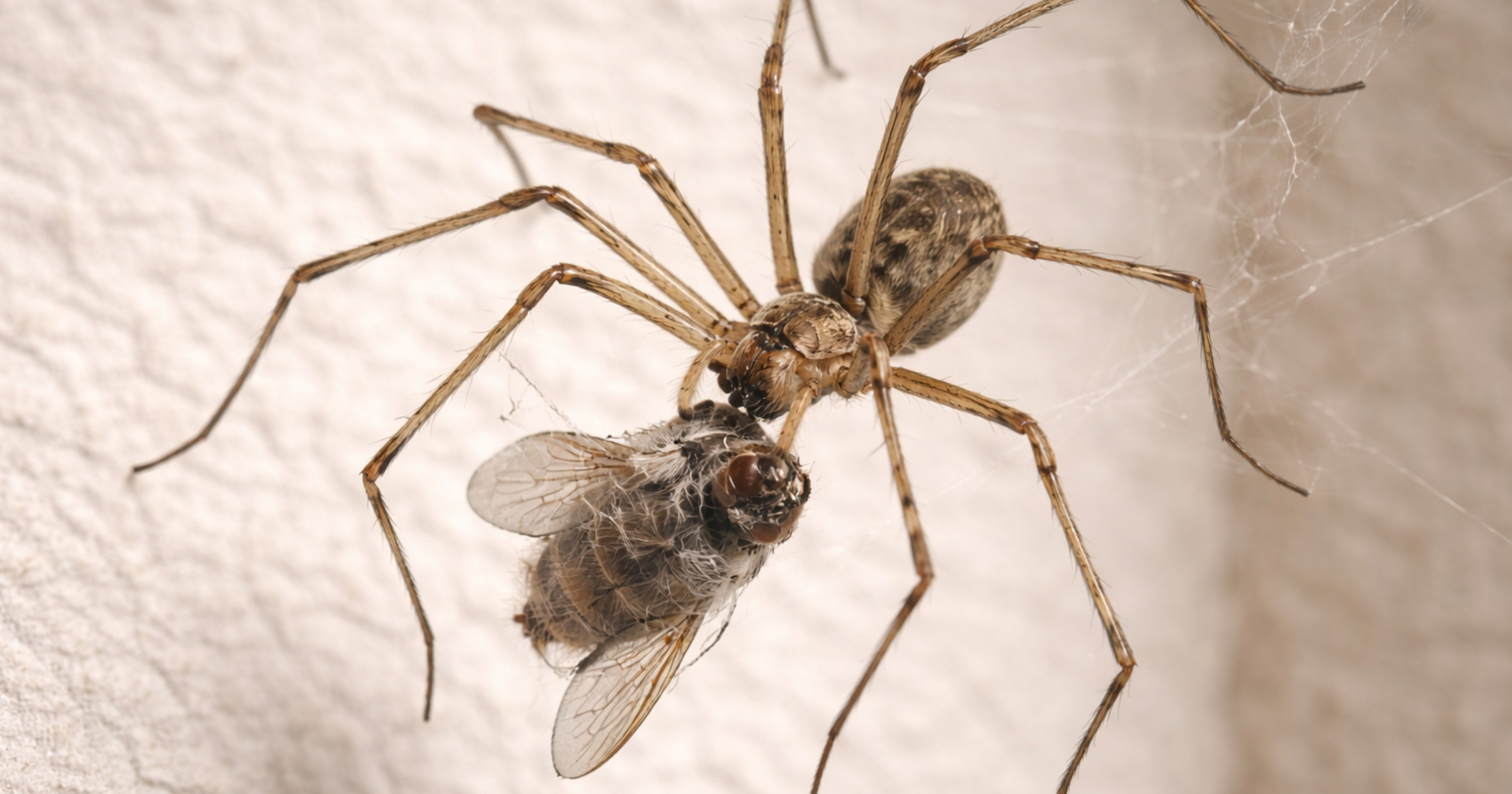
The cellar spider refers to spiders in the family Pholcidae. This matters because the name “daddy long-legs” is confusing: people also use it for harvestmen and crane flies, which are completely different animals. For this page, the correct focus is the cellar spider family, Pholcidae.
Cellar spiders are among the most common spiders found in buildings. They are known for their very long, thin legs, small bodies, loose untidy webs, and a remarkable defence behaviour: when disturbed, many of them vibrate rapidly in the web, which is why they are also called vibrating spiders.
A cellar spider is not a harvestman and not an insect. It is a true spider in the family Pholcidae, within the araneomorph spiders. The family contains more than 2,000 species, and many live in dark, sheltered spaces such as cellars, attics, corners, caves, under bark, and other undisturbed recesses.
Cellar spiders are usually recognised by shape more than colour. Typical features include:
One of the best household clues is the web itself. Cellar spider webs are irregular and messy-looking, not the tidy orb webs of orb-weavers and not the sheet webs of some other house spiders.
These spiders prefer dark, undisturbed spaces. In human buildings they commonly occupy high corners, attics, cellars, garages, sheds, behind furniture, and similar sheltered areas. Natural habitats include caves, loose bark, and protected recesses.
That is why they often seem to “appear” in quiet parts of a house rather than in busy open areas. They favour stability and low disturbance. This is an inference directly supported by where pholcid webs are typically found.
Cellar spiders are not household pests in the same sense as cockroaches or rodents. They are mainly predators. Their webs trap prey without sticky glue; instead, the spiders use the web's irregular structure and then quickly wrap prey in silk. They may eat it immediately or store it.
They also prey on other spiders, including, at times, more medically important spiders. That predatory ability is one reason the old myths around their venom probably spread so widely.
Most people think the cellar spider's biggest strength is its long legs.
That helps, but its more interesting advantage is this:
When disturbed, many cellar spiders shake and vibrate rapidly in their web, blurring their outline and making it harder for predators — and people — to target them accurately. This is one of the family's most distinctive traits and is the reason names like “vibrating spider” and “gyrating spider” are used.
This is not random panic. It is a very effective defensive trick. The spider uses the web almost like a flexible shield, turning itself into a moving blur. In practical terms, that makes it harder to strike, harder to see clearly, and harder to grab.
This is the real “special power”: the cellar spider's hidden advantage is motion camouflage through web vibration. That makes it unusually good at surviving in exposed web positions where other spiders might be easier targets.
A second impressive trait is how cellar spiders handle prey. Their webs are not adhesive, but once something is trapped, the spider rapidly casts silk and wraps it, controlling prey at a relative distance. This helps explain how they can subdue other spiders, including species people see as far more dangerous.
That is a more accurate explanation than saying they are “the most venomous.” Their success comes from web structure, wrapping behaviour, and smart prey handling, not from extraordinary human-danger venom.
The balanced answer is: not in any major medical sense for most people. They can bite, but the popular story that they are secretly extremely dangerous is not supported. The evidence consistently points the other way: cellar spiders are not considered medically significant to humans.
They are successful indoors because they combine:
This means they often do well in parts of buildings that people clean or disturb least: roof corners, behind shelving, in garages, and in storage spaces.
Vacuuming webs and reducing flying prey can lower numbers without drama. For recurring corner buildup or mixed-species uncertainty, get a quote can align identification, hygiene, and quoted spider methodology.
The cellar spider is one of the most misunderstood spiders in buildings. It is not secretly the world's deadliest spider, and it is not just a harmless decoration in the corner either. It is a specialised indoor predator with a very elegant advantage: the ability to turn its own web into a defensive blur while using silk and reach to control prey efficiently. That is what makes the cellar spider so successful.
Next: huntsman spider guide, golden orb weaver guide, wolf spider guide, jumping spider guide, rain spider guide, black button spider guide, brown button spider guide, violin spider guide, sac spider guide, baboon spider guide, how we treat spiders, spider guarantees, spider identification guide. Book spider control in Cape Town. Read spider treatment safety.
Pholcidae — common corner spiders; separate “daddy long-legs” harvestmen and crane flies before you assume identity. Your quote defines treatment scope.
Corners full of webs? Use get a quote for prey context and quoted methodology.
We confirm what you are seeing first, then advise on webs, prey, and quoted control where needed—national spider methodology; your quote prevails.
Huntsman spider guide, Golden orb weaver guide, Wolf spider guide, Jumping spider guide, Rain spider guide, Black button spider guide, Brown button spider guide, Violin spider guide, Sac spider guide, Baboon spider guide, How we treat spiders, Spider guarantees, Spider control by area, Spider identification guide. Hub: spider control.