Pest guide · ant family
The ant that wins by acting like one vast, coordinated organism
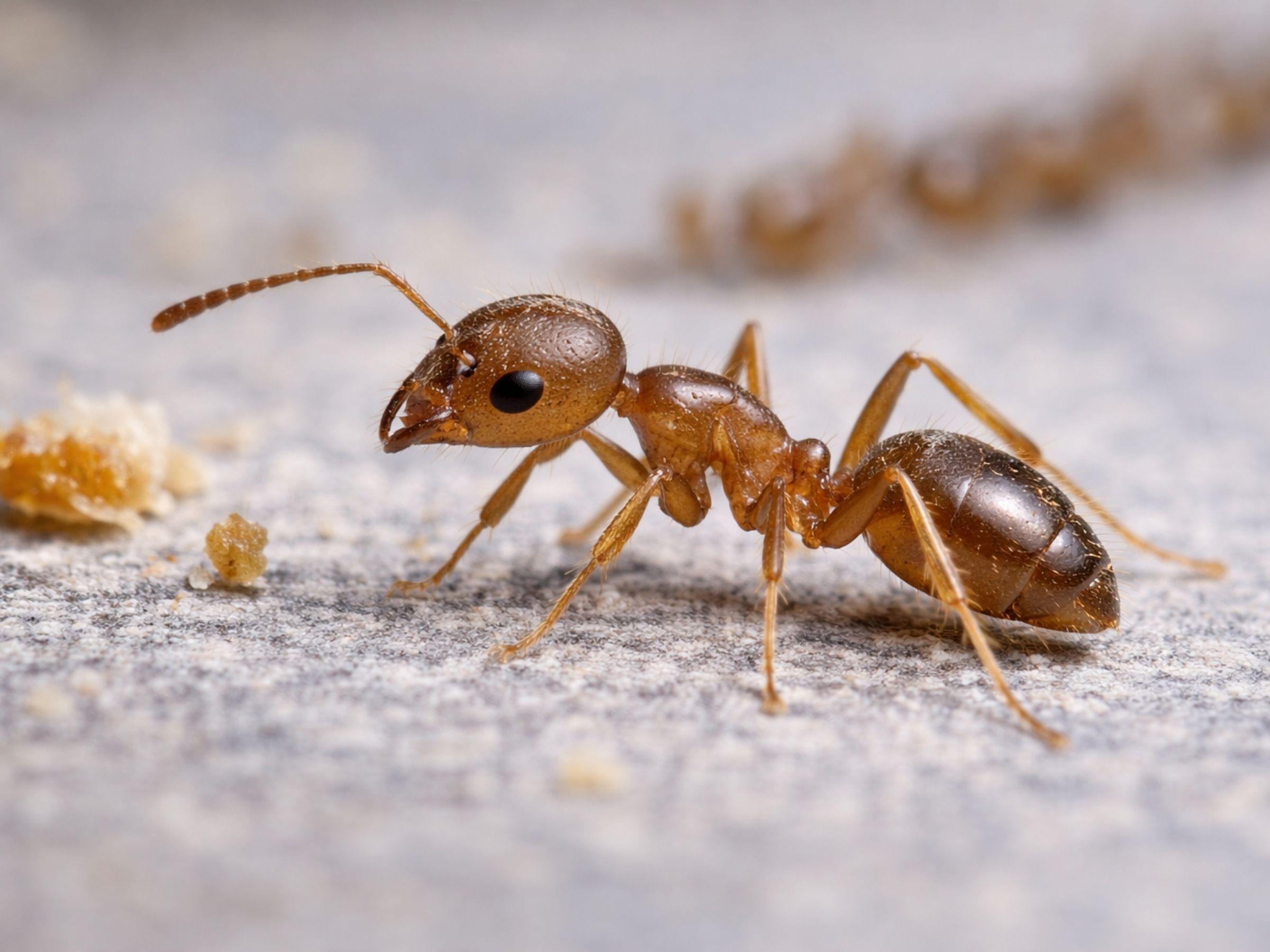
Argentine ants, Linepithema humile, are among the most successful invasive ants on earth. They are small, brown, easy to overlook, and often mistaken for “just another sugar ant.” That is exactly why they become such serious pests. Their danger is not in a sting, a painful bite, or dramatic nest mounds. Their power is in coordination, numbers, mobility, and social structure.
In invaded regions, they often do not live as neat, isolated colonies. Instead, linked nests can function as a supercolony with multiple queens, extensive foraging networks, and very low aggression between nests from the same supercolony. That is one of the main reasons they spread efficiently and outcompete other ants.
Argentine ants are native to parts of South America, but they are now established in many regions with suitable climate—especially Mediterranean-type and some subtropical areas. They do especially well where moisture is available and where people unknowingly help them move in soil, plants, nursery stock, goods, and urban landscapes. Research reviews summarise spread through short-range budding and long-range human transport; they also tend to favour moist habitats: irrigated landscapes, waterways, gardens, and regularly watered sites.
Argentine ant workers are small, fairly uniform in size, and dull brown. Useful field clues include workers that are nearly the same size, a single erect petiole node, and an uneven thorax profile in side view. When crushed, some people notice a musty odour—another practical clue alongside behaviour and habitat.
That uniformity matters. Many homeowners expect obvious majors and minors or obvious soldiers. Argentine ants often do not present that way. A strong, flowing trail of very similar workers is frequently the hint you are dealing with this species rather than a strongly dimorphic ant.
Sweet attraction is real, but shallow descriptions fail. They combine networked colonies, budding, effective recruitment, and habitat flexibility—so they dominate kitchens and paving while also reshaping outdoor ecological interactions where they invade.
In South Africa—especially in Cape contexts tied to sensitive shrubland—Argentine ants are not only a kitchen issue. Local and regional work links invasive ants to disrupted native ant communities and altered myrmecochory (ant-mediated seed dispersal): invaded communities may lose reliable native seed movers while invaders contribute poorly to those plant partnerships. That is a biodiversity and regeneration issue—not an anecdote about crumbs alone.
Moisture and reliable carbohydrates anchor many infestations: irrigation, planters, mulch lines, dripping taps, wall void damp, honeydew partnerships, refuse patterns, and predictable human food trails. Properties can re-infest because the site still feeds the network—not because customers “did nothing wrong” in the kitchen alone.
Solid programmes centre inspection, bait-led colony transfer where labels and species context support it, exclusion where practical, sanitation that removes predictable food trails, and habitat correction—irrigation, planters, pavers, timber on soil—that keeps outdoor networks from constantly resupplying indoors.
University extension summaries for Argentine ants emphasise baiting rather than routine indoor sprays and caution that indoor baiting can sometimes pull more ants through entries—another reason inspection and exterior focus matter. See UC IPM — Argentine ant overview for independent field framing (not a substitute for your technician's label-led plan).
Argentine ants are small invasive ants with an outsized advantage: in invaded areas they frequently behave as cooperative supercolonies—multiple queens, many linked nests, chemically organised trails, and strong budding. That combination drives rapid expansion, repeat household pressure after poor interventions, and serious ecological consequences in sensitive landscapes. Effective control targets the whole network with inspection-bait logic aligned to your site—not only the workers you see on the counter.
When you are ready for colony-focused ant work, start with how we treat ants, confirm guarantee terms, and book a get a quote for a scoped visit. For species comparison at a glance, use our ant identification guide and review ant treatment safety expectations before service.
Short answers aligned with colony-network biology—not spray slogans.
Need colony-focused ant control? Book through our quote flow when you're ready.
Inspection-led baiting and perimeter logic for South African sites: book a quote and we scope the colony footprint with you.
For national methodology and colony logic, start at ant control overview. Compare species on the ant identification guide and read how we treat ants before you book. For pale-foot trails and vegetation-fed Technomyrmex difficilis, see the white-footed ant pest guide and the same Pheidole megacephala story under the name “brown house ant” on the brown house ant pest guide. For glossy indigenous sweet-trail context for Lepisiota capensis, see the black sugar ant pest guide. For canopy cocktail ants (Crematogaster peringueyi), see the cocktail ant pest guide. For adaptable glossy household trails (Ochetellus glaber), see the copper-bellied ant pest guide.