Pest guide · ant family
The white-footed ant is one of those pests people underestimate at first. It looks small, neat, and almost harmless, but Technomyrmex difficilis can build enormous, multi-nest populations, flood structures with workers, protect honeydew pests outdoors, and persist because of a highly unusual reproductive system. Its real strength is not aggression alone. It is colony design.
For modern pest work, the white-footed ant is best treated as Technomyrmex difficilis. That matters because this ant was historically confused with Technomyrmex albipes, and older sources often mixed the two. AntWiki treats T. difficilis as the relevant species and describes it as a widespread tramp ant and household pest.
This is important for a guide page because a lot of recycled online content still blends the names together. A proper pest page should say clearly that the operational species focus is Technomyrmex difficilis, not just “some white-footed ant.”
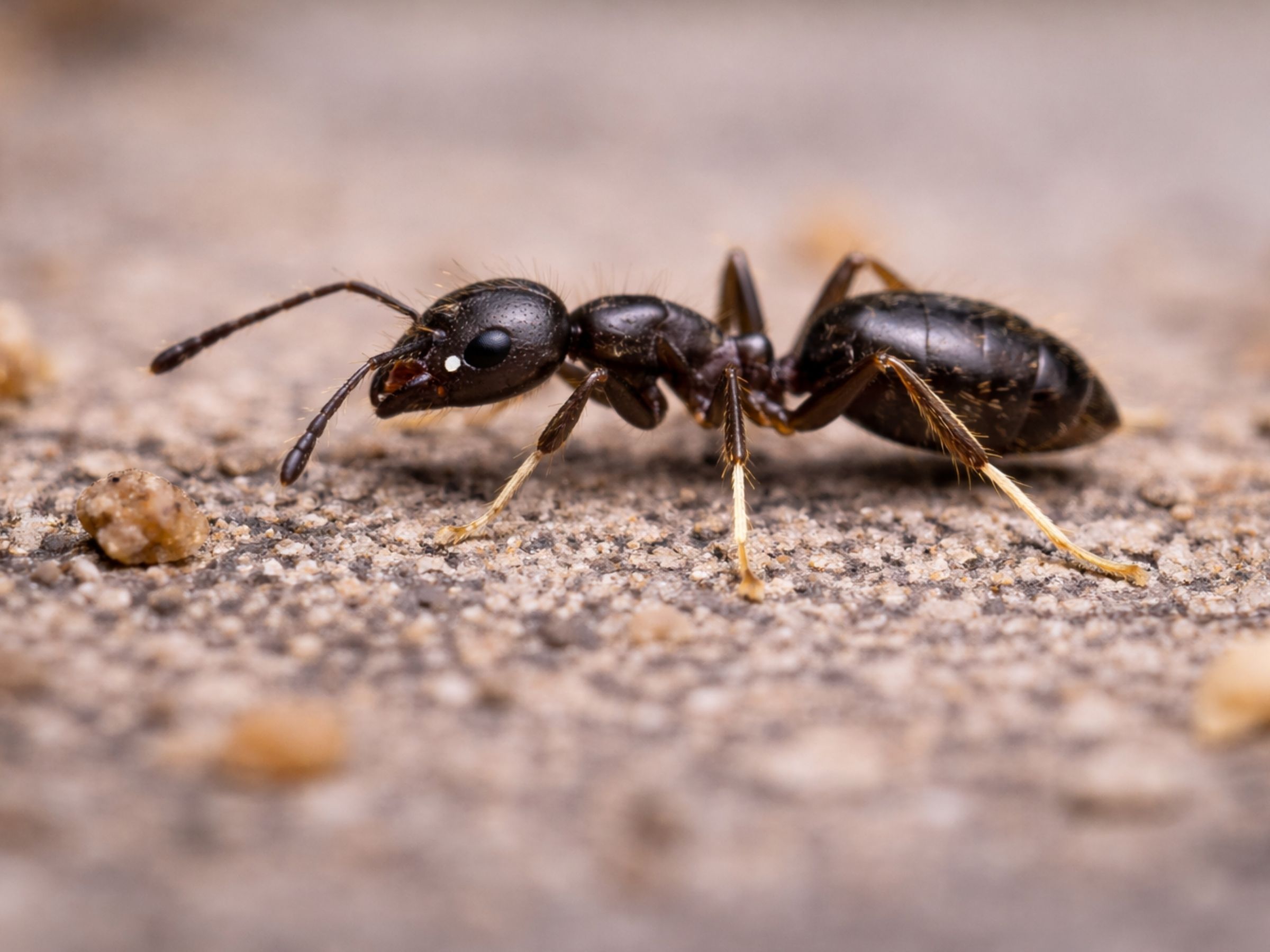
Because the lower parts of the legs, especially the tarsi, are much paler than the rest of the body. The ant is typically dark brown to blackish, while the feet and lower leg segments look pale or whitish by contrast. That colour contrast is one of the easiest field clues.
White-footed ants are small, dark ants with distinctly pale feet. They are slender rather than bulky, and they often move in large numbers along fixed routes on walls, branches, fences, trunks, cables, and structure edges. AntWiki describes them as arboreal and tramp-like, nesting in a wide range of protected sites and foraging broadly.
What to look for
White-footed ants are highly adaptable and often nest in trees, shrubs, leaf litter, cavities, wall voids, roof spaces, and other protected crevices. They are especially successful where there is vegetation near structures, because they readily forage on plants for honeydew and then spill over into buildings. AntWiki and invasive-population work both describe them as successful tramp ants with strong capacity to establish in human-modified environments.
This ant is not mainly famous because of painful attacks. Its pest importance comes from scale.
White-footed ants can build very large, diffuse populations and send huge numbers of workers into structures. They are also closely tied to honeydew-producing insects, which means shrubs, ornamental plants, fruit trees, and landscaped areas can function as outdoor feeding engines for the colony. Once that system is established, interior nuisance activity can continue even when people only focus on the ants they see indoors.
In plain language, this is often not just an indoor ant problem. It is a vegetation-fed, multi-nest colony problem.
Most people assume the white-footed ant's advantage is simply that it has “lots of workers.”
That is only the visible part.
Its deeper advantage is its replacement-based reproductive system. AntWiki notes that queens in these colonies eventually die off and are replaced by reproductive worker-queen intercastes, with multiple grades of these forms present. This is a very unusual and very important colony trait.
Many ant pests depend heavily on ordinary queens and classic colony founding. White-footed ants have something more flexible: a colony can keep reproducing through intercastes, which are female reproductives that are intermediate between workers and queens. That makes the colony less dependent on the simple “kill the queen and it ends” picture people often imagine.
The hidden power is reproductive resilience. This ant does not just spread because it forages well. It spreads because the colony has a built-in way to replace reproductive function from within, helping it persist, fragment, and recover. That is one of the best explanations for why it can feel so stubborn in the real world.
Recent population-genetic work on invasive Technomyrmex difficilis found strong evidence of polygyny and low differentiation consistent with heavily connected populations. In practical pest terms, that means what looks like one infestation may actually be a linked cluster of nests and reproductives.
That is a major reason this ant punches above its size. A networked colony system can keep feeding, reproducing, and shifting pressure even when part of it is disturbed.
Not in the same way as pugnacious ants or some stinging ants. Their power is less about dramatic attack behaviour and more about numbers, persistence, connectivity, and sustained foraging pressure. That distinction matters. White-footed ants win by organization and continuity, not by brute confrontation.
If you want one accurate answer, it is this:
It turns reproduction into resilience.
Many ants are fast. Many ants use trails well. Many ants like sweets. Many ants enter buildings. But the white-footed ant stands out because it combines:
That combination makes it much harder to exhaust than people expect.
The white-footed ant is a brilliant example of how a pest can be powerful without looking dramatic. Technomyrmex difficilis succeeds through coordination, fragmentation, and a highly unusual reproductive backup system. Its hidden edge is not size or ferocity. It is the ability to keep the colony alive, linked, and expanding even when conditions change. That is what makes this ant such a formidable pest — and such an extraordinary animal.
When you are ready for colony-focused ant work, start with how we treat ants, confirm guarantee terms, and book a get a quote for a scoped visit. For species comparison at a glance, use our ant identification guide and review ant treatment safety expectations before service.
Short answers focused on species identity, multi-nest pressure, and reproductive resilience—not generic spray advice.
Need vegetation-aware, colony-scoped ant control? Book through our quote flow when you're ready.
We inspect exterior honeydew engines and interior pressure together—then scope label-led ant control to your site.
Contrast multi-nest outdoor networks with the Argentine ant pest guide, indoor fragmentation with the Pharaoh ant pest guide, and aggression-plus-honeydew dynamics with the Pugnacious ant pest guide. National methodology: ant control overview.