Pest guide · ant family
Same species as the big-headed ant guide (Pheidole megacephala)—this page uses the South African common name “brown house ant.”
The brown house ant is one of South Africa's most important pest ants. Known scientifically as Pheidole megacephala, it is the same species also called the big-headed ant. Its success does not come from size alone. It comes from mass cooperation, multiple queens, multiple nests, worker specialization, and an extraordinary ability to dominate disturbed environments.
The brown house ant is Pheidole megacephala. In South African and broader international sources, this species is also called the big-headed ant, African big-headed ant, and coastal brown ant. IUCN GISD lists “brown house-ant” as one of its accepted common names, and South African literature explicitly refers to Pheidole megacephala as the brown house ant.
This matters because many people assume “brown house ant” is a separate house-ant species. In this context, it is not. It is the same highly successful ant already known globally for invasive dominance.
The name brown house ant sounds like a generic label for any small brown ant found near a home. That is one reason people misidentify it. But in South African pest and agricultural usage, the name has long been tied specifically to Pheidole megacephala. Older South African references, citrus IPM material, and invasive-species databases all support that usage.
Better truth: “Brown house ant” is a common name, not a scientific diagnosis. But when used properly in South Africa, it generally means Pheidole megacephala.
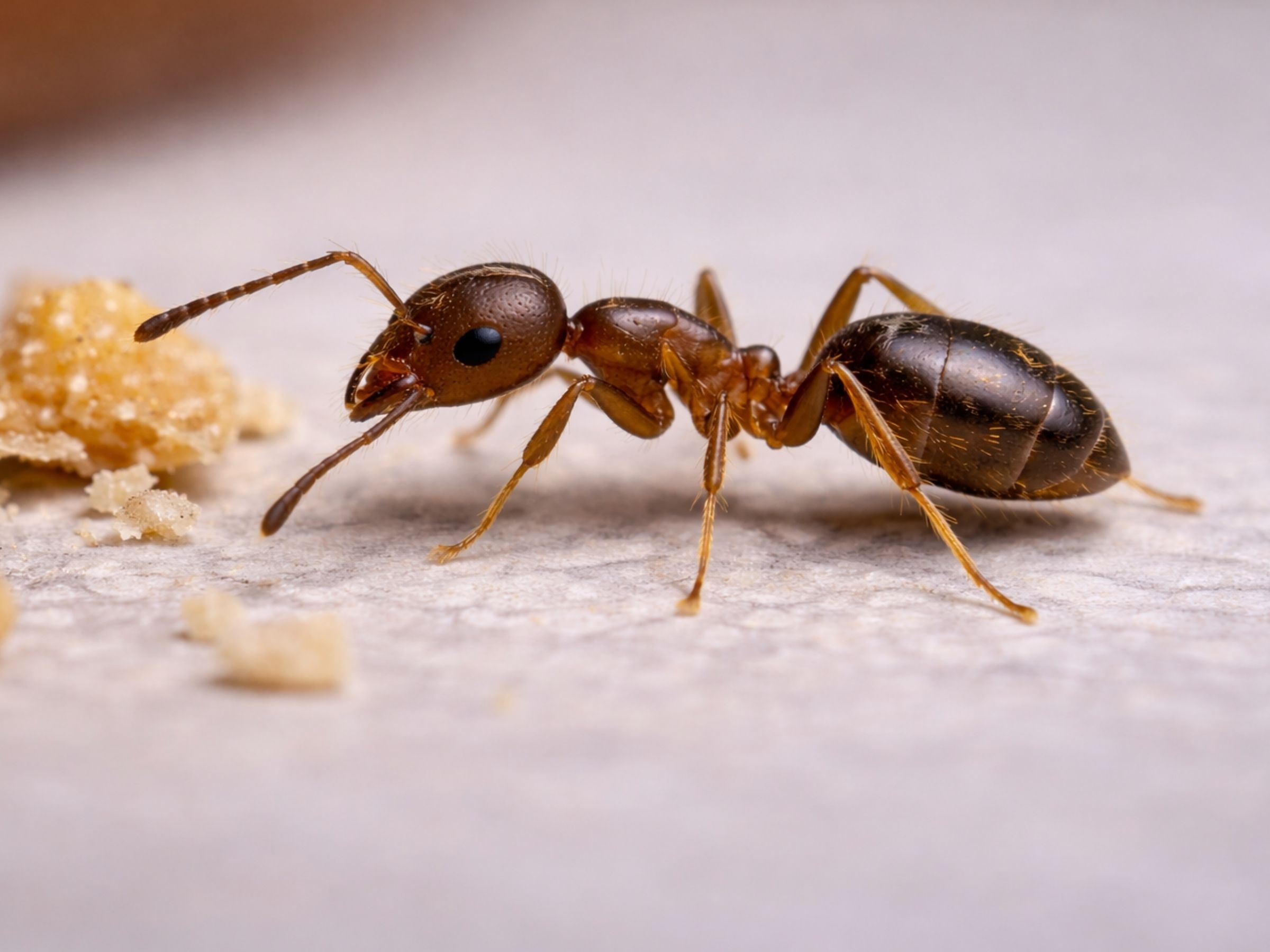
Brown house ants are usually yellowish-brown to reddish-brown, but colour alone is not enough for reliable identification. The real clue is that the colony has two worker forms:
What to look for
Brown house ants do especially well in warm, disturbed habitats. South African sources describe them as common in citrus and other managed settings, while international reviews show they thrive in urban, landscaped, agricultural, and other disturbed environments.
That is why they are often found around:
Brown house ants matter because they are not just foragers. They are system-builders.
In southern African citrus, they are among the most problematic ants because they attend honeydew-producing insect pests, protecting them from natural enemies. That means the ants help scale insects, mealybugs, aphids and similar pests persist and worsen.
IUCN GISD also notes that Pheidole megacephala is one of the world's worst invasive ants because it displaces native invertebrates and supports plant-damaging sap feeders.
In plain language: The brown house ant is often not just “the ant problem.” It is the ant that protects the real plant pest problem.
Most people think its advantage is simply the large-headed soldier caste. That is only the surface. Its deeper advantage is colony-scale cooperation.
Research summaries and supercolony literature show that Pheidole megacephala can function in supercolonial or highly cooperative multi-nest systems. Instead of wasting energy constantly fighting nearby colonies of their own species, these ants can expand through broad areas with reduced internal conflict.
That lets them pour more energy into:
The brown house ant's hidden power is social scale. Not just big heads. Not just numbers. But a cooperative multi-nest system with specialized workers. That is what makes it feel relentless once established.
This species has true worker dimorphism. That means the major workers and minor workers are not just different sizes by accident. They are part of a labour system built into the colony. Reviews on Pheidole megacephala describe the species as having a distinct soldier caste with disproportionately enlarged heads and mandibles.
That makes the colony more efficient:
So the “big head” is not cosmetic. It is part of a designed social machine.
Brown house ants are difficult because they combine:
IUCN GISD also notes reports of this species damaging irrigation tubing, electrical wires, and telephone cabling, which shows that the problem is not always limited to nuisance or agriculture.
There is evidence in the literature that what has long been treated as Pheidole megacephala may actually include cryptic species within the invasive complex. That means the biology behind the brown house ant is even more complex than most pest pages suggest.
That does not change the practical pest message, but it does underline how biologically sophisticated this ant really is.
If you want the most accurate single answer, it is this:
It turns colony life into scalable power.
Many ants have soldiers. Many ants recruit quickly. Many ants like honeydew. Many ants become nuisance pests. But the brown house ant stands out because it combines:
That is why it can dominate so effectively.
The brown house ant is one of those pests whose common name makes it sound ordinary. It is not ordinary at all. Pheidole megacephala is a highly organized, deeply successful ant built around specialization, cooperation, and expansion. Its soldiers are striking, but the real secret lies deeper: a colony system that behaves more like a spreading network than a single nest. That is what makes this ant such a formidable pest around homes, landscapes, and crops.
For the same species under the other widely used name, read the big-headed ant pest guide. When you are ready for colony-focused ant work, start with how we treat ants, confirm guarantee terms, and book a get a quote for a scoped visit. Compare species on the ant identification guide and review ant treatment safety expectations before service.
Straight answers on Pheidole megacephala naming and multi-nest biology—aligned with South African pest usage.
Need majors-on-trail context scoped to your property? Book through our quote flow when you're ready.
We inspect nest footprint, vegetation partners, and label-led baiting—book a quote for technician-led ant control.
Same species, other common name: big-headed ant pest guide. Contrast with supercolony Argentine dynamics on the Argentine ant pest guide and indoor Pharaoh fragmentation on the Pharaoh ant pest guide. National methodology: ant control overview.