Pest guide · ant family
Species anchor: Ochetellus glaber. Common names vary; “copper-bellied” reflects bronze or coppery gaster tones in some lighting—not every region uses the label for the same lookalike.
Ochetellus glaber — black house / black household ant
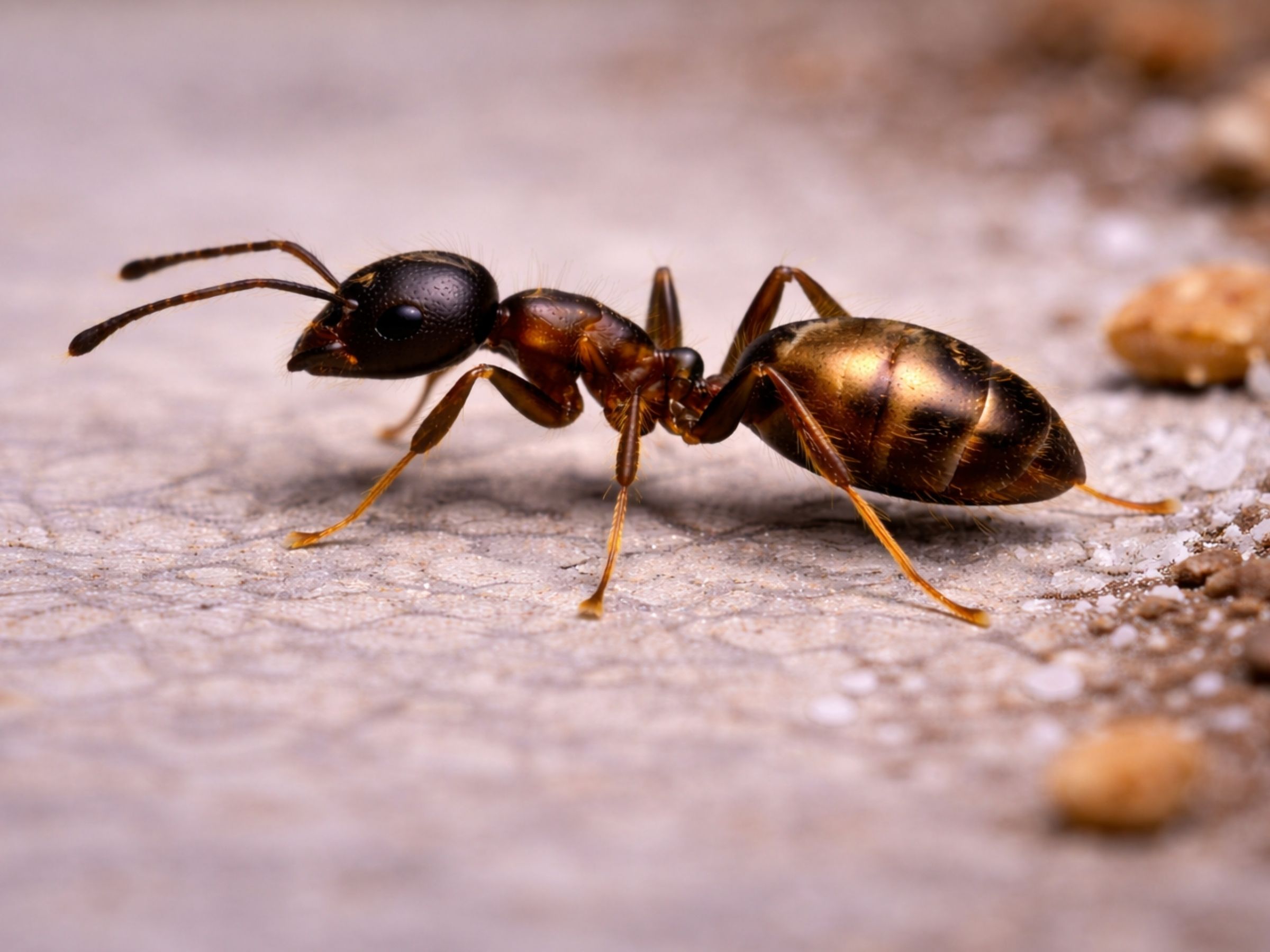
The copper-bellied ant is small, glossy, and easily underestimated. Ochetellus glaber is not famous because it is terrifying. It is famous because it is adaptable. This ant can nest in wood, walls, stems, paving and tree cavities, trail into houses for food and moisture, and switch what it seeks depending on the colony's needs. That flexibility is what makes it such a persistent pest where it becomes established.
The copper-bellied ant is generally identified as Ochetellus glaber, a small ant in the subfamily Dolichoderinae. It is also widely known as the black household ant. Sources describe it as native to Australia and established in a number of other places, including Hawaii, Florida, New Zealand, Japan, India and other parts of the Indo-Pacific.
That matters because common names can be messy. “Copper-bellied ant” is not the main scientific label; it is one of several everyday names attached to Ochetellus glaber. The species itself is the important anchor—on this site we use that anchor for garden and household pest behaviour, including South African properties where this ant is part of the introduced household ant complex.
This is a small ant, with workers generally about 2–3 mm long. It is usually described as brown to black, often shiny, with a distinct upright petiole and a smooth, neat appearance. Some forms or lighting conditions show a more bronze or coppery abdomen, which helps explain the common name.
What to look for
A useful practical point: this ant is often unremarkable at first glance. It is not especially large, and in some invaded areas pest authorities note that its size, speed and trailing habits can seem “typical” compared with other household ants. That is part of why people often misjudge it.
This is one of the most important truths about the species.
The copper-bellied ant is extremely flexible about nesting sites. Sources describe it nesting under stones, in old dry logs and rotten wood, in hollow trees, in plant stems, in fenceposts, and in buildings, including paving, ceilings and walls.
That means it is not just a ground ant and not just a tree ant. It can operate across arboreal, structural and ground-linked spaces. This is one of the main reasons it becomes such a stubborn nuisance indoors and around gardens.
In its native range it is associated with open or semi-open habitats, and in introduced areas it does particularly well in dry to mesic environments and human-modified settings. Landcare Research (New Zealand) notes it is well adapted to open or semi-open habitats and is often found in domestic gardens, while Hawaiian pest authorities note that it becomes especially common in homes during dry spells as it searches for moisture indoors.
Typical problem areas
The copper-bellied ant is mainly important for nuisance pressure, not because it is a dangerous stinging ant.
Hawaiian pest authorities describe it as a significant indoor nuisance that readily invades kitchens, bathrooms and bedrooms, feeding on crumbs and becoming more noticeable during extended dry periods. They also note that it does not sting, though it can deliver an annoying bite.
It also matters outdoors because it forages for honeydew and small insects and can be an agricultural nuisance through tending homopterous pests such as aphids and mealybugs. That means, like several successful pest ants, it may indirectly worsen plant-pest pressure by protecting sap-feeding insects.
In plain language: This ant is not scary because it is violent. It is successful because it is persistent, flexible, and opportunistic.
Here is the part most people never hear.
The copper-bellied ant's lesser-known edge is nutritional flexibility linked to brood demand. Research on Ochetellus glaber found that its foraging for proteins and carbohydrates depended on both food type and the amount of brood present. In other words, the colony does not just “like sweet things” in a fixed way. It can shift what it prioritises depending on whether it has more developing young to feed.
That is a serious adaptive advantage.
A colony that can shift its food priorities with its internal needs is harder to outcompete and often harder to bait consistently. It helps explain why pest authorities in Hawaii say the species does not consistently respond to typical ant baits: some days it takes the bait, some days it does not.
Not venom. Not brute force. Not giant soldiers.
Its hidden power is colony-level diet flexibility. The colony can adjust what it seeks according to need, especially brood demand. That makes it a very efficient survivor.
A second trait makes this ant unusually effective around people.
It does not just move over the ground. It forages and nests in a three-dimensional way:
That means it can bridge the gap between garden, structure and indoor space very easily. Many ants are mainly soil-focused. This one is much more versatile.
The copper-bellied ant does not have the dramatic branding of a trap-jaw ant, pugnacious ant or big-headed ant. It is small, often glossy black, and easy to dismiss.
But biologically it has a very strong survival package:
That combination makes it one of those ants that is not dramatic, but annoyingly good at winning.
The copper-bellied ant is a good reminder that the most successful pests are not always the most dramatic. Ochetellus glaber wins through adaptability. It can live in trees, wood, walls and paving, move between garden and structure, forage by day or night, and adjust what it seeks according to the colony's needs. That is what makes it such an effective household and garden pest — and such a clever little ant.
Contrast with showier species on the Pugnacious ant pest guide or Big-headed ant pest guide, review how we treat ants, confirm guarantee terms, and book a get a quote. Compare glossy trails on the black sugar ant pest guide (Lepisiota capensis) and use the ant identification guide before service. Read ant treatment safety.
Ochetellus glaber — nuisance, nesting flexibility, and brood-driven foraging (not a “super-aggressive” storyline).
Indoor files or wall lines? Book through our quote flow when you want inspection-led ant control.
We inspect nesting footprint and foraging pressure—then scope label-led ant control to your site.
Small glossy natives vs introductions: Black sugar ant pest guide. Aggressive soil giants: Pugnacious ant pest guide. National methodology: ant control overview.