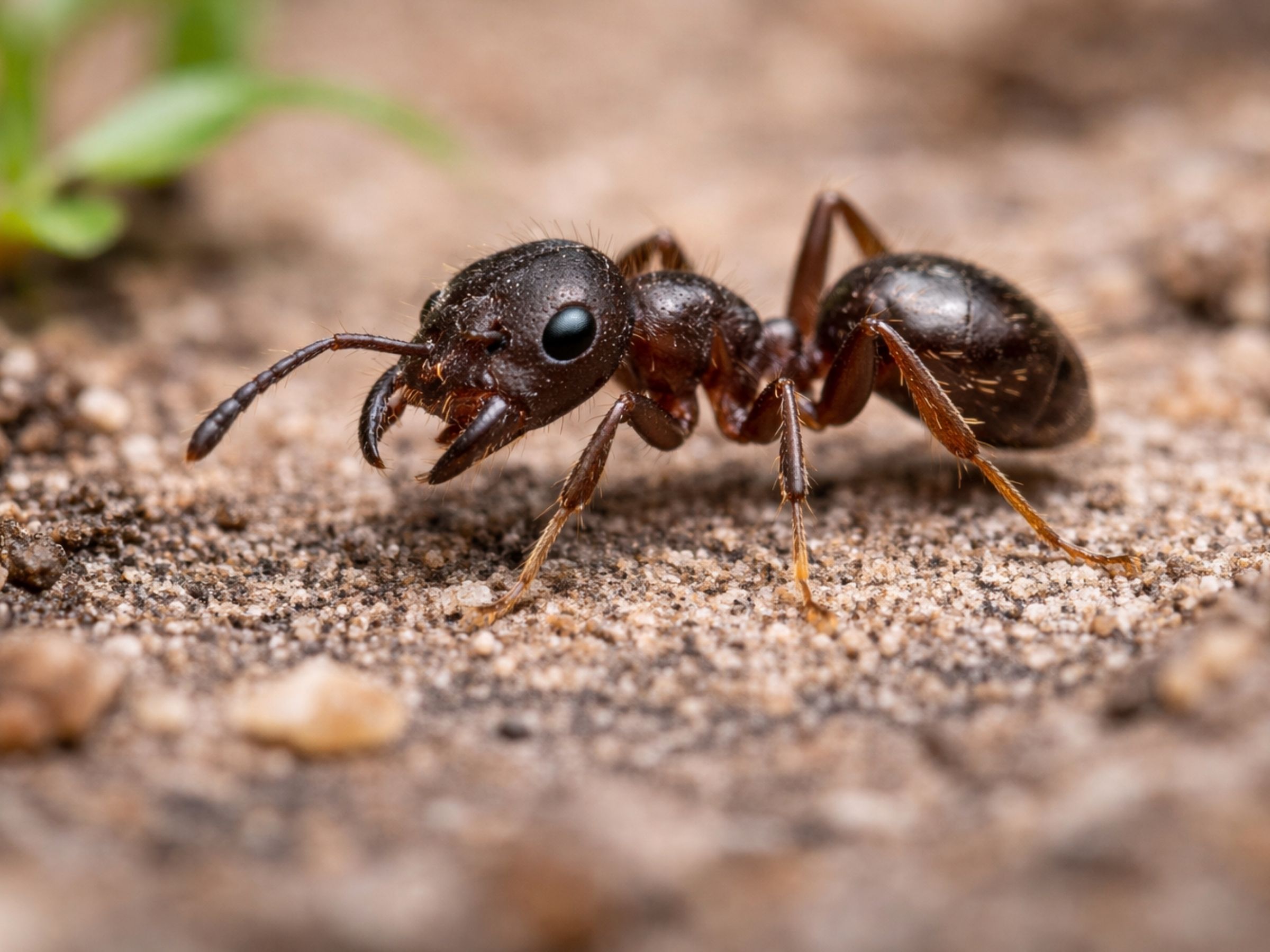
Pest guide · ant family
Fast, aggressive, and brilliantly organised, the pugnacious ant is one of southern Africa's most formidable native ants. Around homes, gardens, vineyards and orchards, it can become far more than a nuisance. Its real strength is not just aggression. It is a combination of speed, chemical defence, food-source loyalty, and a flexible worker system that lets the colony exploit the ground and vegetation with remarkable efficiency.
In South Africa, “pugnacious ant” is a common name used loosely, but for a serious pest guide the main species to focus on is Anoplolepis custodiens, the Large Pugnacious Ant. SANBI lists it under that English common name and records it as indigenous in South Africa. Taxonomic summaries describe it as common and abundant in southern Africa—well known to people living where it occurs.
Common names blur species together. There is also a Small or Black Pugnacious Ant, Anoplolepis steingroeveri, and the two can be confused in the field. This page focuses clearly on A. custodiens.
Because it does not behave like a timid ant. Sources describe A. custodiens as aggressive and fast-moving: when workers interpret something as a threat, they can swarm and attack. That is one reason the species is so memorable in the Western Cape and elsewhere in southern Africa. The reputation is real—the name is not an exaggeration.
The pugnacious ant is not always as visually uniform as people expect. Workers can vary in size and colour—one reason homeowners assume they are seeing several different ants. Summaries note noticeable worker variation in A. custodiens; darker individuals can resemble A. steingroeveri. A chequered-looking pattern on the abdomen is often cited as a helpful clue for A. custodiens.
What to look for
SANBI records Anoplolepis custodiens as indigenous in South Africa. The species occurs widely in southern Africa in dry, open, and cultivated habitats—so it matters around buildings, gardens, orchards, and vineyards, not only in wild landscapes.
Pugnacious ants are primarily soil nesters. Visible traffic on paving, walls, plants, or lawns does not necessarily show where the nest sits—the colony can remain protected below while activity looks dramatic above. Work in orchards and vineyards also shows nest position and foraging can shift with food rewards, especially when ants tend honeydew-producing pests.
They do not usually threaten structures like termites. The pest significance is strategic: honeydew is part of the diet, and tending honeydew-producing pests drives agricultural harm. South African research described mutualism between A. custodiens and the mealybug Planococcus citri on guava—both populations rose together; excluding ants allowed predators and disease to hit mealybugs harder. Ants even shifted nests nearer the honeydew source.
In vineyards, A. custodiens is discussed as a major indirect pest because ants protect vine mealybugs, undermining biological control. The ant becomes a problem not only through aggression but because it helps other pests survive.
In plain language: this ant often acts like a bodyguard for sap-sucking pests. A property can look like an “ant problem” when the real system is ant + mealybug / aphid / scale.
Most people assume aggression is the whole story. The less widely known advantage is worker polymorphism paired with surface-specific deployment. Research reported preliminary evidence linking worker size to where ants patrol: all sizes moved on the ground, while shrubs were dominated almost entirely by the smallest workers—suggesting a relationship between body size and foraging substrate.
This is something people often get wrong. The pugnacious ant is a formicine ant. Reviews of formicine venoms describe the group as non-stinging, with defence built on concentrated formic acid rather than a stinger like many imagine. They bite, swarm, and spray acid-based venom—to a person it may feel like being stung, but biologically that is not the same as a typical sting.
Aggression, recruitment, honeydew loyalty, and nest mobility stack together. Vineyard baiting research found that at wide bait spacing, low-toxicity bait reached only a fraction of A. custodiens workers compared with Argentine ants—meaning sparse bait grids can look “ineffective” when the programme is simply under-dosed for how this species uses space. Your technician maps placement to the real foraging geometry and label options on your quote.
Conservation literature highlights native seed-dispersing ants—including pugnacious ants—displaced in the Cape by invasive Argentine ants. The species can be ecologically important, not only annoying. They are also significant prey—for example, dietary studies on pangolins and aardvarks report Anoplolepis custodiens as a major food component. That does not make them welcome on your stoep—but it explains why they are biologically heavyweight ants, not merely “rude insects.”
One accurate summary: aggression plus organisation. Many ants are quick; many tend honeydew; many use chemical defence. Anoplolepis custodiens combines rapid swarm response, acid-based defence, loyalty to profitable food sources, flexible worker structure, and effective use of both soil and vegetation—why it dominates in the right environment.
The pugnacious ant is one of the most impressive and misunderstood ants in southern Africa—not merely an angry insect, but a native, highly organised, chemically defended species with a hidden edge: flexible workers using ground and vegetation layers efficiently. That is what makes it successful—and stubborn when human uses overlap with its foraging logic.
For colony-targeted work, move from this guide to how we treat ants, confirm guarantee terms, compare species on the ant identification guide, and book a get a quote. Review ant treatment safety before service day.
Answers grounded in indigenous-species biology and field behaviour—not panic labels.
Ready for inspection-led ant control? Use the quote flow when you want a scoped visit.
We inspect soil lines, vegetation, and honeydew partnerships—then scope bait-led control to your site and quote.
Compare with the Argentine ant pest guide for invasive supercolony dynamics and the white-footed ant pest guide for pale-foot nuisance ants with heavy honeydew ties. For arboreal black cocktail ants (Crematogaster peringueyi) on vines and woody plants, see the cocktail ant pest guide. For national methodology, start at ant control overview.