Pest guide · ant family
The big-headed ant is not just another nuisance ant. Pheidole megacephala is one of the most dominant ant species on earth—famous for forming vast cooperative colonies, overwhelming native ants, protecting plant pests, and thriving in disturbed urban and agricultural habitats. Its real strength is not just aggression. It is social scale, worker specialization, and colony cooperation on a massive level.
The big-headed ant, Pheidole megacephala, is a small ant with a huge global reputation. The IUCN Global Invasive Species Database describes it among the world's worst invasive ants; AntWiki likewise classifies it among the most problematic invasive ants worldwide. It is thought to originate in southern Africa but has spread widely through tropical and subtropical regions.
For South Africa that dual identity matters: it belongs to this region's broader native heritage, yet in many other countries it behaves as a highly destructive invader—so local pest pressure can sit alongside global invasion-biology fame.
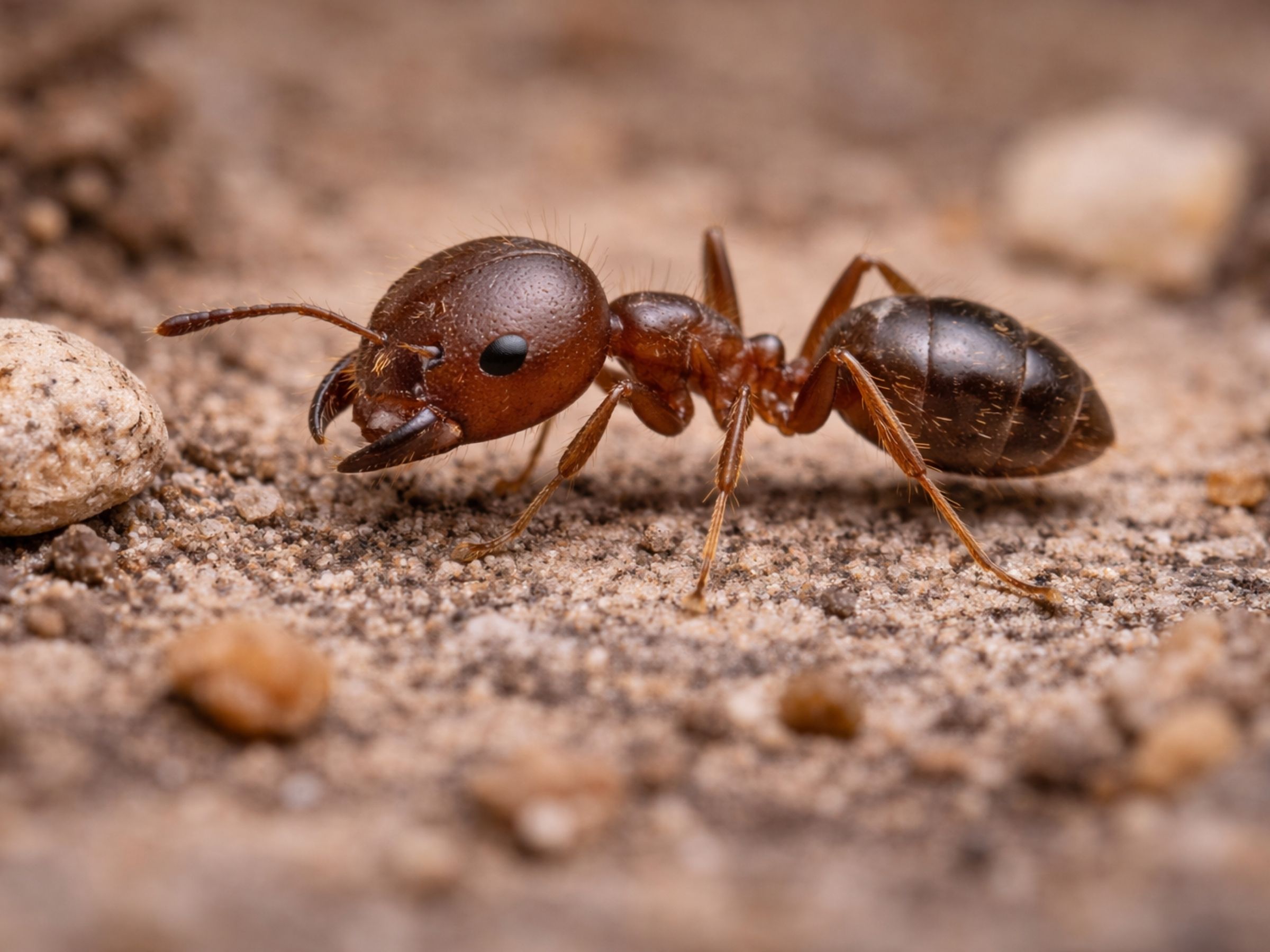
Because one worker caste really does have an outsized head. Colonies contain minor workers and major workers; the majors—often called soldiers—have greatly enlarged heads and powerful mandibles. That dimorphism is a defining feature, not a cosmetic quirk: it underpins how the species partitions labour and force.
Big-headed ants are usually yellow-brown to reddish-brown, but colour alone is not enough. The stable clue is two distinct worker forms in the same colony:
What to look for
Big-headed ants thrive in open, disturbed habitats—summaries emphasise weedy urban, landscaped, and agricultural spaces where Hemiptera provide steady honeydew. They often become prominent around:
1. They displace other ants and invertebrates
The species is known for overwhelming native ant communities and reshaping invertebrate assemblages. The IUCN database notes serious biodiversity risk through displacement of native fauna. Field work elsewhere reported biomass of P. megacephala orders of magnitude above native ants in infested sites compared with reference areas—illustrating how dominance scales biologically, not only visually.
2. They protect plant pests
Like other dominant pest ants, big-headed ants tend honeydew producers—including phytophagous Hemiptera that reduce yield. Summaries tie their success to abundant plant-feeding pests; in plain terms the ant becomes a force multiplier for sap-feeding outbreaks.
In plain language: this ant is rarely “only ants.” It often escalates other pest problems by guarding honeydew sources—so control thinking has to follow the whole system, not only the ants on the surface.
People fixate on the soldier's oversized head—that is only part of the truth. The deeper advantage is division of labour combined with supercolony-style structure. AntWiki and supercolony literature describe P. megacephala as supercolonial: vast numbers of nests can behave with very low aggression between cooperative nestmates across large areas—functionally one giant population rather than many tiny warring colonies.
Most ants burn energy fighting rivals of the same species. Where big-headed ants reduce that internal conflict, more effort flows to expansion, recruitment, resource capture, overwhelming competitors, and defending honeydew lines.
Majors are a true specialized caste—not a curiosity. Pronounced worker dimorphism is relatively uncommon among ants at this level of spectacle; the enlarged head houses musculature and mandible power used in defence, milling, and resource handling. The large head reflects evolutionary role design inside the colony, not “smarter” ants.
Huge numbers, multiple nests, cooperation across nests, worker specialization, strong fit to disturbed habitats, and honeydew mutualisms combine into a species that does not merely tolerate people—it frequently takes over space. The IUCN database also notes reports of chewing damage to irrigation lines, cabling, and electrical wires—so impacts can extend beyond nuisance and ecology into infrastructure maintenance.
Recent synthesis in supercolony biology suggests what we label Pheidole megacephala may encompass cryptic lineages—both described as supercolonial invaders. That does not change day-to-day pest decisions on your property, but it explains why invasion researchers keep returning to this ant: its biology is deeper than a single tidy public story.
One accurate summary: it scales power socially. Many ants recruit or exploit honeydew; fewer combine caste specialization, vast cooperative structure, low internal conflict across nests, and aggressive takeover of disturbed habitats. That stack is why P. megacephala lands on global worst-invader lists while still emerging from southern African landscapes.
The big-headed ant is a clear example of power without individual size: Pheidole megacephala succeeds through organisation, specialization, and social scale. Oversized soldiers impress, but the deeper engine is a colony built to expand, cooperate, defend, and dominate—that is what makes it both an extraordinary animal and a formidable pest when it intersects homes, farms, and infrastructure.
Continue to how we treat ants, read guarantee terms, browse ant identification, and book a get a quote. See ant treatment safety before technicians arrive.
Species facts without hype—mapped to what you see on site.
Want inspection-led ant control? Start from the quote flow when you are ready.
We scope multi-nest pressure, plant pest context, and label-led baiting—book a quote for a technician visit.
Compare supercolony dynamics on the Argentine ant pest guide and native aggressive-forager context on the Pugnacious ant pest guide; for slender pale-foot ants on vegetation and walls, see the white-footed ant pest guide. For the same species under the South African label “brown house ant,” see the brown house ant pest guide. National methodology lives at ant control overview.