Pest guide · ant family
Species focus: Crematogaster peringueyi (Black Cocktail Ant). Overseas “cocktail ant” labels may point to unrelated ants—this guide is written for South African pest and vineyard context.
Crematogaster peringueyi — black cocktail ant
The cocktail ant is one of South Africa's most distinctive ants. Quick, alert, and highly at home above ground, it is famous for raising its abdomen like a tiny scorpion when disturbed. But its real power is not drama. It is an arboreal specialist with strong defensive chemistry, smart nest-building behaviour, and an important ability to protect honeydew-producing pests in gardens, vineyards, and shrubs.
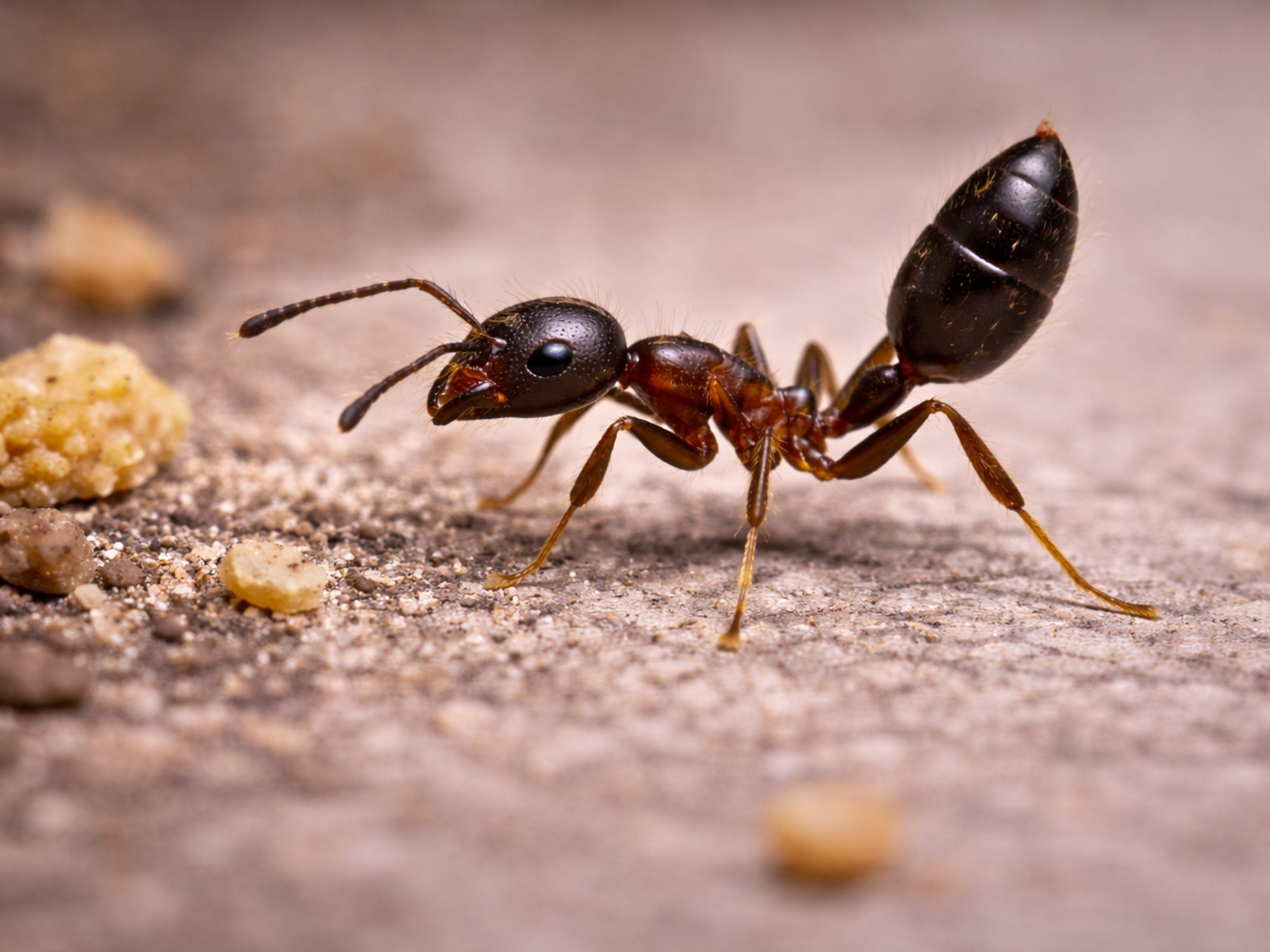
In South Africa, “cocktail ant” most commonly refers to Crematogaster peringueyi, often called the Black Cocktail Ant. It is a southern African species in the genus Crematogaster, a group of ants known for lifting or curling the abdomen when alarmed. That posture is the reason for the “cocktail” name and for the Afrikaans name wipgatmier.
This is important because “cocktail ant” is not a precise name worldwide. In Australia and elsewhere, other unrelated ants also carry “cocktail ant” in their common names. For a South African pest guide, the correct focus is Crematogaster peringueyi.
Because of its posture. When threatened, Crematogaster peringueyi arches its abdomen upward over the body. This tail-up posture is one of the clearest features people notice. South African natural-history sources specifically describe the species as being known for this raised-abdomen behaviour when alarmed.
That behaviour is not just display. It is tied to its defensive chemistry.
The black cocktail ant is generally described as a small, glossy black to dark brown ant, with workers roughly 3–5 mm long and a queen around 8 mm long. Its abdomen is often described as heart-shaped, which is a classic feature of many Crematogaster ants.
What to look for
The cocktail ant is primarily an arboreal species. That makes it very different from many nuisance ants people see mainly in paving or lawn edges. South African sources describe it nesting in:
This means the cocktail ant is especially at home in:
Most people think the cocktail ant's greatest feature is the raised abdomen. That is only the visible part. Its deeper advantage is that it is an arboreal specialist. South African sources describe cocktail ants as largely arboreal, often trailing through vegetation, with well-developed ability to grip vertical and even inverted surfaces. In practice, that gives them a huge advantage in shrubs, branches, bark, canopies, trellises, and vine systems where many other ants are less efficient.
This makes the cocktail ant more than just a nuisance ant on plants. It is an ant designed to live, move, defend, and feed in elevated plant structure. That means it can:
Its real special power is three-dimensional arboreal control. It is not just living in the garden. It is controlling the architecture of the plant itself: bark, twigs, flowers, branch forks, cavities, and canopy routes. That makes it extremely efficient in vineyards, ornamental trees, shrubs, and plant-heavy properties.
This is one of the least appreciated traits of the cocktail ant. Sources describe Crematogaster peringueyi building nests from well-chewed vegetable matter with a papier-mâché consistency, blackened by salivary secretions. These nests can be roughly spherical, with irregular connected internal chambers, almost sponge-like in structure.
That is not a trivial detail. It means the species is not limited to naturally existing hollows. It can also manufacture protected living space in the canopy.
A species that can use cavities is adaptable. A species that can also build elevated shelter is even stronger.
This gives the cocktail ant a real strategic edge:
That nest-building ability is one of the reasons this ant is so well suited to woody vegetation.
The cocktail ant's signature posture is strongly tied to its chemical defence. South African descriptions note that the raised abdomen ends in a sting-like tip, but that this is not used like a typical sting. Instead, it is used to release volatile defensive chemicals. Pest sources also note that threatened workers release a repulsive odour.
Important correction: Many people assume the ant is preparing to sting. That is usually a partial truth at best. The better description is that the ant is preparing to aim or emit defensive chemicals, not to sting like a bee or a true stinging ant.
So the “tail-up” posture is not theatre. It is part of a targeted chemical defence system.
The cocktail ant is not famous because it destroys wood or eats buildings. Its pest importance is more subtle. Research from South African vineyards shows that Crematogaster peringueyi is an indirect pest because it interferes with natural enemies of scale insects and other honeydew-producing pests. Vineyard studies have reported it disrupting biological control contexts involving soft brown scale and vine mealybug, and bait surveys have ranked it among dominant indirect vine pests alongside species such as the pugnacious ant.
In plain language: The cocktail ant often becomes a problem because it protects plant pests. That means the visible ant activity is sometimes only part of the issue. The larger problem may be aphids, scales, mealybugs, or other sap-feeding insects producing honeydew.
So when cocktail ants are active on shrubs, vines, or ornamentals, it is often worth checking the plant carefully for the insects they may be guarding.
If you want the most accurate answer, it is this:
It combines arboreal movement, nest-building, and chemical defence unusually well.
Many ants can climb. Many ants use scent. Many ants exploit honeydew. But the cocktail ant stands out because it combines:
That combination makes it especially effective in shrubs, trees, vineyards, and garden canopies.
The black cocktail ant does not only use existing cavities. It can create papery black carton nests from chewed plant material and saliva, with internal chambers arranged like a coarse sponge. That makes it not just a plant-dwelling ant, but a genuine canopy architect.
That is one of the most interesting and least-known reasons it succeeds so well in woody vegetation.
The cocktail ant is one of South Africa's most elegant examples of how an ant can become formidable without being large. Crematogaster peringueyi succeeds through elevation, architecture, and chemistry. It lives where many ants are less effective, builds where others merely occupy, and defends itself with a highly distinctive raised-abdomen chemical system. That is what makes it so memorable — and what makes it such a capable pest in the right setting.
Compare vineyard and honeydew context with the Pugnacious ant pest guide, review how we treat ants, confirm guarantee terms, and book a get a quote. Use the ant identification guide for species comparison and read ant treatment safety before service.
Arboreal Crematogaster peringueyi—posture, nests, and indirect vineyard/plant pest roles.
Activity on vines or shrubs? Book through our quote flow when you want inspection-led ant control.
We inspect canopy routes, honeydew partners, and nest sites—then scope label-led ant control to your property.
Vineyards and honeydew: Pugnacious ant pest guide. Pale-foot structural traffic: White-footed ant pest guide. Sweet trails at ground level (different genus): Black sugar ant pest guide. National methodology: ant control overview.