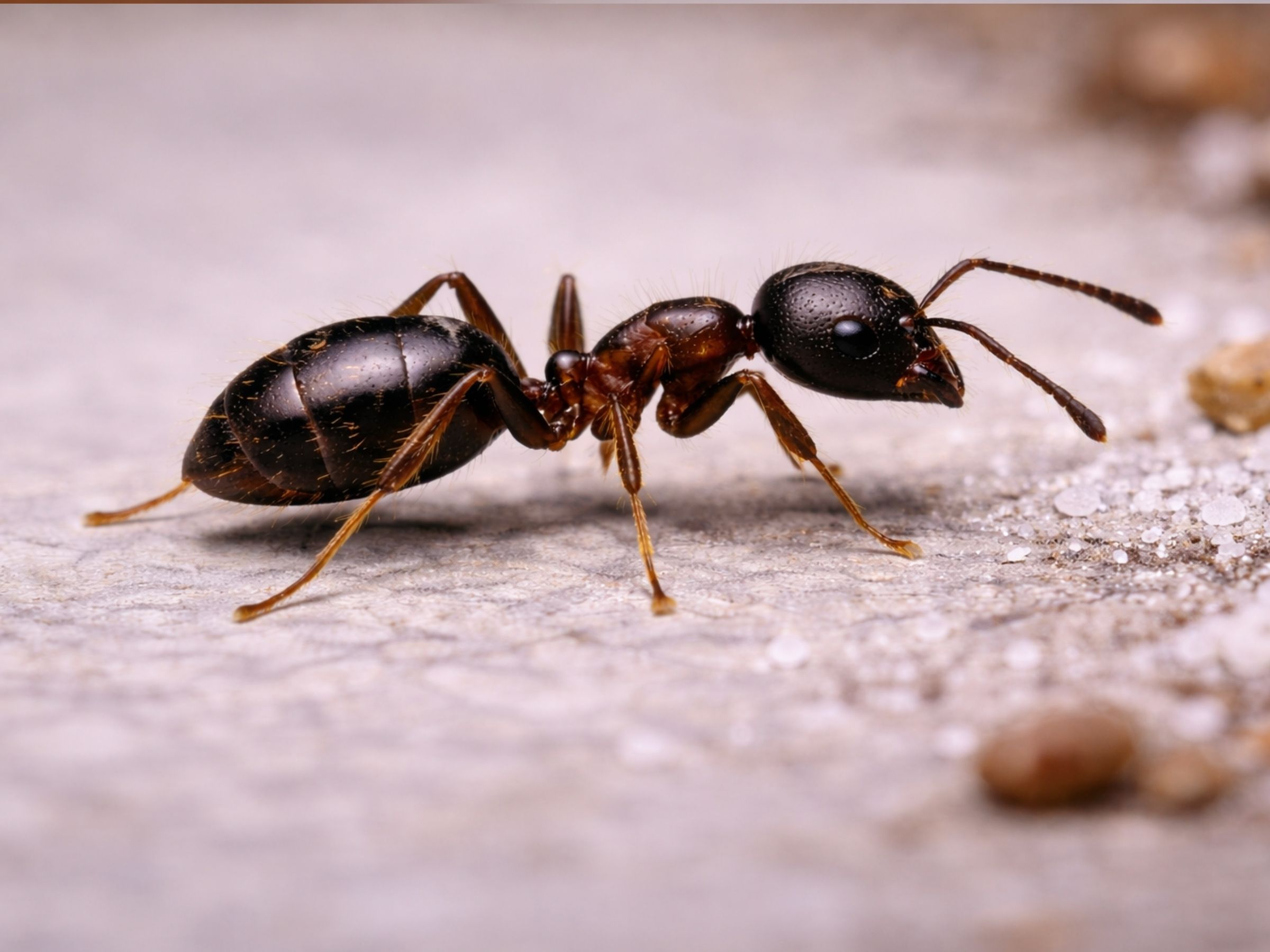
Pest guide · ant family
Species focus: Lepisiota capensis (small black sugar ant). This page is not about Australian banded sugar ants, North American odorous house ant stories, or other overseas “sugar ant” labels.
Lepisiota capensis — small black sugar ant
Small, dark, fast and often overlooked, the black sugar ant is one of southern Africa's familiar native ants. In South Africa, the name most often points to Lepisiota capensis, a sugar-feeding formicine ant that can forage around vegetation, tend sweet-producing insects, and play an ecological role far bigger than its size suggests. Its real strength is not brute force. It is adaptability, sweet-resource tracking, and integration into living plant systems.
The small black sugar ant, Lepisiota capensis, is an Old World ant in the subfamily Formicinae. It is recorded from South Africa and elsewhere in the Afrotropical region, and South African sources specifically refer to it as an indigenous ant.
Because it is strongly associated with sweet food sources, especially sugary secretions in the environment. One of the clearest signs of this in the field is its association with plant lice and other honeydew-producing insects. Species-level accounts for Lepisiota capensis describe behaviours consistent with tending and harvesting honeydew—exactly what the sugar-ant name implies.
Black sugar ants are small, dark, glossy ants. Reliable images and specimen references show a distinctly dark to black body with relatively slender proportions.
What to look for
This is where the black sugar ant becomes much more interesting than the average pest page suggests. South African biodiversity literature notes that small black sugar ants are indigenous ants that matter in wider ecosystems. They are specifically mentioned among the native ants harmed by the invasive Argentine ant, and those native sugar ants play important roles in systems tied to seed dispersal and butterfly ecology.
The lesser-known strength of the black sugar ant is not aggression in the pugnacious-ant sense, and not oversized caste specialization like the big-headed ant. Its real edge is that it is part of a group of ants that are deeply effective at exploiting sugary plant-linked resources while still functioning as important ecological partners.
In South African literature, Lepisiota capensis is singled out as a major host ant for some Aloeides butterflies. That tells you something important: this is not just a random scavenger. It is a stable, ecologically embedded ant that other species have evolved to depend on.
An ant that can reliably exploit sweet food sources, persist in habitat, and form stable associations with other organisms gains a major survival advantage. In nature, long-term reliability can be just as powerful as aggression. That is part of what makes black sugar ants so successful. This line of reasoning follows from documented sugar-linked behaviour and host-ant roles—not from exaggerating nuisance claims.
Because Lepisiota capensis is a formicine ant, it belongs to a subfamily known for formic-acid-based chemical defence rather than a typical sting. So if people loosely say sugar ants “sting,” that is usually not the best biological wording for this kind of ant—another reason to avoid copy-pasted overseas pest articles that assume a different ant identity.
For a pest website, the black sugar ant is useful because it sits at the border between nuisance pest and ecological actor. It may forage around homes, gardens, and plantings in search of sugary resources, but it is also part of native systems that invasive ants can damage. That gives you a more intelligent page than a generic “small black ant” article—and it keeps the story honest when customers see trails near kitchens and ornamentals.
The black sugar ant proves that a small ant does not need dramatic weapons to be successful. Lepisiota capensis thrives through resource awareness, sugar-source tracking, ecological partnerships, and adaptability. That is what makes it such a successful native ant — and why a proper pest guide should treat it as more than just another small black ant. This summary is drawn from its documented identity, sugar-linked behaviour, and ecological associations described in South African and regional sources—not from recycled overseas sugar-ant pages built on the wrong species.
Compare invasive pressure with the Argentine ant pest guide, review how we treat ants, confirm guarantee terms, and book a get a quote when you want a scoped visit. Use the ant identification guide for side-by-side species context and read ant treatment safety before service.
Species-accurate answers for Lepisiota capensis—not overseas sugar-ant hand-me-down copy.
Sweet trails indoors or on plants? Book through our quote flow when you're ready for inspection-led ant work.
We inspect for species clues and invasive/native context—then scope label-led ant control to your property.
Native vs invasive contrast: Argentine ant pest guide. Major/minor castes (different species): Big-headed ant pest guide / Brown house ant pest guide. Pale-foot honeydew networks: White-footed ant pest guide. National methodology: ant control overview.