Pest guide · ant family
The Pharaoh ant is one of the most deceptive pest ants in the world. It is tiny, pale, and easy to underestimate, yet it can build large, multi-queen infestations inside heated buildings, split into new nests when disturbed, and become especially problematic in sensitive sites like hospitals and food-handling areas. Its real strength is not size or aggression. It is colony fragmentation with survival built into it.
The Pharaoh ant, Monomorium pharaonis, is a tiny tramp ant that has spread worldwide and is best known as a persistent indoor pest. AntWiki describes it as essentially cosmopolitan and capable of nesting within heated structures; USDA extension material highlights relevance in hospitals, homes, schools, restaurants, and stores.
Despite the name, it is not an “Egyptian ant” in any practical identification sense—the label is historical. What matters operationally is that it is an indoor-adapted, warm-building specialist.
Pharaoh ants are not simply wandering kitchen visitors. USDA sources flag special concern in healthcare because ants can mechanically move pathogens and exploit wall voids, electrical routes, linen storage, food zones, and sterile corridors—behaviour that separates them from larger outdoor-foraging species.
Their impact stacks from several traits:
Together those traits create infestations that resist spray-first thinking.
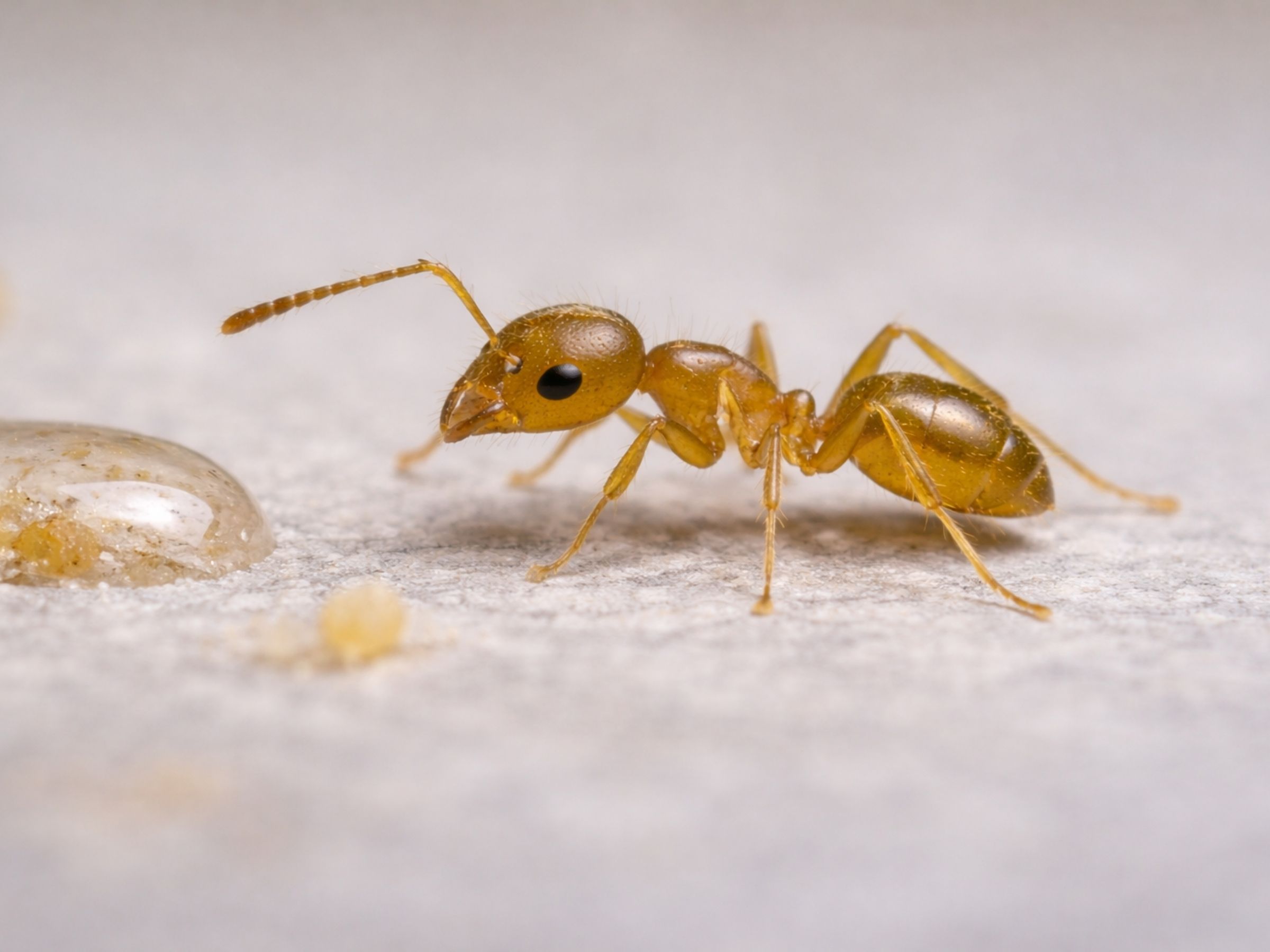
Workers are very small— commonly about 1.5–2 mm—pale yellow to yellowish-brown, often with a darker gaster. Diagnostic summaries note 12-segmented antennae with a three-segmented club and monomorphic workers: one worker size, unlike big-headed ants with obvious soldiers.
What to look for
People often mistake them for “baby ants.” They are adult workers of a tiny species—that mistake delays proper ID and control planning.
Pharaoh ants exploit very small, warm, protected voids. Literature lists wall voids, appliance insulation, behind skirting, linens, electrical outlets, and hot-water services—often far from the few workers you notice on a counter. The trail you see may be only the visible edge of a multi-site indoor population.
Size is only half the story. The decisive trait is budding: highly polygynous colonies can shed fragments of workers, brood, and queens to seed new nests nearby. The colony does not bet everything on one queen or one cavity— it fragments under pressure and keeps reproducing.
That is why disturbance without species-aware strategy can feel like the ants “suddenly appear everywhere.”
Pharaoh ants are described as extremely polygynous—many queens coexist—so losing one queen rarely ends the episode. Nutrient-regulation research on the species reflects that queen-rich architecture. In pest terms the infestation looks indestructible because redundancy is baked in.
USDA references emphasise hospitals and care facilities: mechanical pathogen movement plus penetration of sterile or high-risk wards. Historical reporting ties them to intensive care, neonatal units, burns wards, and similar spaces. Not every home case equals a clinical emergency—but the species earns a sanitation reputation beyond kitchens.
Minute workers, cryptic warm nests, many queens, budding, generalist feeding, and corridor-foraging across connected utilities create a textbook case where biology beats brute spraying. Species-aware baiting and disciplined placement— aligned to your technician's assessment—matter more than volume of repellent product.
Pharaoh ants are not famous for bites or big nests—they win because colonies are engineered for modular survival: redundant queens, satellite nests, and fragmentation under stress. Hidden persistence is the defence.
One accurate answer: disturbance becomes expansion. Many pests weaken when disrupted; Pharaoh ants frequently respond by budding through cracks, ducts, cupboards, and service channels—behaviour that feels uncanny until you map the biology.
The Pharaoh ant wins through social engineering: tiny workers, concealed nests, many queens, and budding that turns pressure into spread—not through size or sting. That design makes it one of the cleverest indoor pests Verminator technicians plan around, always with label-led bait strategy and sensitive-site discipline.
Next steps: how we treat ants, guarantee terms, ant identification, get a quote, and ant treatment safety.
Bait-led thinking for a budding species—no sensationalism.
Need a scoped indoor ant programme? Use the quote flow when you are ready.
Species-aware baiting and disciplined placements—book a quote for technician-led indoor ant control.
Contrast indoor budding with multi-nest outdoor species on the Argentine ant pest guide, exterior honeydew-fed networks on the white-footed ant pest guide, and caste-heavy dominance on the Big-headed ant pest guide. National methodology: ant control overview.